
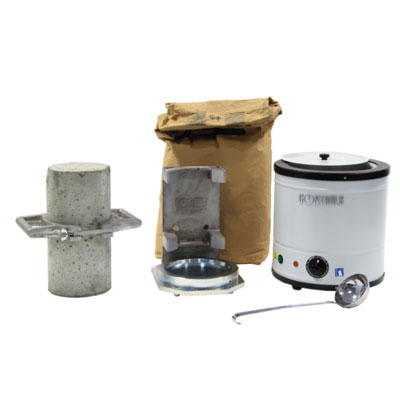
Cylinder Capping
Precision Cylinder End Preparation for Accurate Concrete Compression Testing
Cylinder Capping is a critical specimen preparation process used before conducting the compressive strength test on concrete cylinders. The purpose of capping is to create smooth, flat, and parallel bearing surfaces at both ends of the concrete specimen, ensuring uniform load distribution during testing.
Improper end preparation can result in uneven stress distribution, inaccurate compressive strength values, and premature specimen failure. Therefore, cylinder capping is an essential part of quality control in concrete testing laboratories.
At QC LAB Solution Bangladesh, we supply premium-quality Cylinder Capping Equipment, sulfur capping compounds, neoprene capping systems, and accessories designed to meet international testing standards for accurate and repeatable compression testing.
What is Cylinder Capping?
Cylinder capping is the process of preparing the ends of hardened concrete cylinders before compression testing. The capping material fills surface irregularities and creates level bearing surfaces, allowing the compression testing machine to apply the load evenly across the specimen.
Depending on the applicable standard and testing requirements, cylinder ends may be prepared using:
- Sulfur mortar capping
- High-strength gypsum capping
- Neoprene pad capping systems
- Precision grinding or end grinding machines
Importance of Cylinder Capping
Proper cylinder capping helps to:
- Ensure uniform load distribution.
- Improve compressive strength accuracy.
- Eliminate surface irregularities.
- Reduce testing errors.
- Improve repeatability of laboratory results.
- Comply with international testing standards.
- Support Quality Assurance (QA) and Quality Control (QC).
- Increase confidence in structural performance evaluations.
Methods of Cylinder End Preparation
1. Sulfur Capping
A molten sulfur compound is poured into a capping plate, and the concrete cylinder is positioned to form a smooth and level bearing surface. This is one of the most widely used methods in laboratories.
2. Neoprene Pad Capping
Reusable neoprene pads are placed inside steel retaining caps and fitted onto the cylinder ends. This method offers fast specimen preparation and is widely used for routine quality control testing.
3. End Grinding
A precision grinding machine removes surface irregularities from both ends of the cylinder, producing perfectly flat and parallel surfaces without using capping materials.
4. High-Strength Gypsum Capping
Special gypsum-based compounds may also be used where permitted by applicable testing standards.
Equipment Required
A complete Cylinder Capping setup may include:
- Cylinder Capping Frame
- Sulfur Capping Pot
- Sulfur Melting Furnace
- Capping Plates
- Cylinder Alignment Device
- Neoprene Capping System
- Steel Retaining Caps
- End Grinding Machine
- High-Strength Sulfur Capping Compound
- Protective Safety Equipment
Key Features
High-quality Cylinder Capping Equipment offers:
- Heavy-duty steel construction
- Accurate cylinder alignment
- Uniform capping thickness
- Fast specimen preparation
- Heat-resistant components
- Durable and corrosion-resistant finish
- Easy operation
- Low maintenance
- Long service life
- Compliance with international standards
Applications
Cylinder Capping Equipment is widely used in:
- Construction material testing laboratories
- Ready-mix concrete plants
- Civil engineering laboratories
- Government quality control agencies
- Universities and research institutions
- Infrastructure projects
- Cement manufacturing laboratories
- Precast concrete factories
- Bridge and highway projects
- Industrial construction quality control
Common Testing Standards
Cylinder capping equipment is designed to comply with internationally recognized standards, including:
- ASTM C617/C617M – Capping Cylindrical Concrete Specimens
- ASTM C1231/C1231M – Use of Unbonded Caps in Determination of Compressive Strength
- ASTM C39/C39M – Compressive Strength of Cylindrical Concrete Specimens
- AASHTO T22 – Compressive Strength of Cylindrical Concrete Specimens
- EN 12390-3 – Compressive Strength of Test Specimens
- BS EN 12390
- IS 516 – Methods of Tests for Strength of Concrete
Compliance with these standards ensures accurate and repeatable compressive strength results.
Benefits of Using Cylinder Capping Equipment
Using professional Cylinder Capping Equipment provides:
- Accurate compressive strength testing
- Uniform specimen preparation
- Reduced testing variability
- Faster laboratory workflow
- Improved quality control
- Compliance with international standards
- Long-lasting equipment performance
- Cost-effective specimen preparation
Why Choose QC LAB Solution Bangladesh?
QC LAB Solution Bangladesh is a trusted supplier of civil engineering and construction material testing equipment, providing complete laboratory solutions for concrete, cement, aggregates, asphalt, soil, rock, and geotechnical testing.
Our Advantages
- Premium-quality Cylinder Capping Equipment
- High-performance sulfur and neoprene capping systems
- ASTM, AASHTO, EN, and IS compliant solutions
- Professional installation and commissioning
- Calibration and maintenance support
- Technical training
- Reliable after-sales service
- Competitive pricing
- Fast delivery throughout Bangladesh
- Expert laboratory consultation
Our commitment is to provide reliable laboratory equipment that delivers accurate, repeatable, and internationally accepted testing results.
Conclusion
Cylinder Capping is an essential step in preparing concrete cylinders for compressive strength testing. By creating smooth and parallel bearing surfaces, capping ensures uniform load application and accurate test results.
With advanced Cylinder Capping Equipment from QC LAB Solution Bangladesh, laboratories and construction professionals can improve testing accuracy, maintain compliance with international standards, and achieve reliable quality control for every concrete project.
Frequently Asked Questions (FAQs)
1. What is Cylinder Capping?
Cylinder capping is the process of preparing the ends of concrete cylinders to create smooth, flat, and parallel surfaces before compressive strength testing.
2. Why is cylinder capping important?
Proper capping ensures uniform load distribution, improves test accuracy, reduces testing errors, and complies with international testing standards.
3. What methods are used for cylinder end preparation?
Common methods include sulfur capping, neoprene pad capping, end grinding, and high-strength gypsum capping.
4. Which standards are commonly followed?
Cylinder capping is commonly performed according to ASTM C617, ASTM C1231, ASTM C39, AASHTO T22, EN 12390-3, and IS 516.
5. Why choose QC LAB Solution Bangladesh?
QC LAB Solution Bangladesh offers premium cylinder capping equipment, sulfur capping compounds, neoprene capping systems, technical support, calibration services, and dependable after-sales service for laboratories and construction projects across Bangladesh.