
Resistivity Meter, Digital is a precision measurement instrument, and Resistivity Meter, Digital Price in Bangladesh is a frequently searched term among geotechnical engineers, geophysicists, environmental consultants, and field survey professionals. Designed to measure electrical resistivity accurately, this device helps users analyze subsurface conditions and gather essential data for a wide range of investigation projects.
Analog Resistivity Meter is a trusted geophysical testing instrument, and Analog Resistivity Meter Price Price in Bangladesh is a commonly searched term among geologists, engineers, environmental consultants, and survey professionals. Designed to measure electrical resistivity in soil and subsurface formations, this instrument provides reliable data for a wide range of field investigation and exploration projects. Built for dependable performance, the analog resistivity meter offers accurate measurements that help professionals assess underground conditions effectively. Its straightforward analog display allows users to monitor readings directly, making it a practical choice for field operations where simplicity and reliability are essential. The instrument supports efficient data collection and contributes to informed decision making during surveys and investigations.
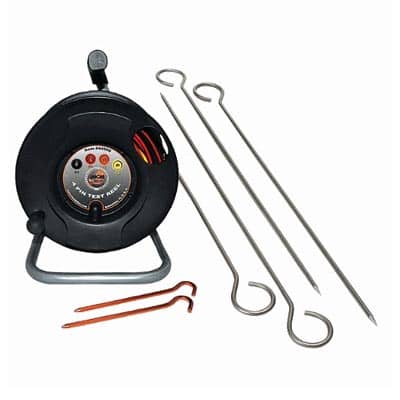
Four pin, test reel set for attaining 1-20 ft. depth measurements. Can be used with any 4-terminal meter. Uses 4-electrode Wenner method. Includes 4 separate, color-coded wires of varying lengths from 5 to 65 ft. Jumper leads (2-foot) are supplied for connection to meter.
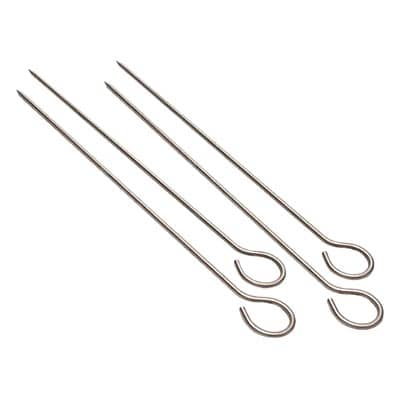
The Soil resistivity test kit is designed to conveniently store and carry all that is necessary to perform the Wenner Four-Pin Method, as outlined in the ASTM G57-06 Standard, as well as the Soil-Box Method. The kit includes: (1) large Soil Box; Soil container test leads set, (1) set of 4-Pin Test Reel leads; 4-Pin soil resistivity test reel, (4) Heavy-duty, stainless steel, 18" long, T-handle, Soil pins and carrying case.
The Soil Box can be used with both resistivity meters for a quick and accurate measurement of the resistivity of a soil or water sample in the field or laboratory. Construction is clear plastic with stainless steel current plates and brass potential pins. The dimensions are such that the measured resistivity with the Resistivity Meter, when the box is filled level, can be expressed in ohm-centimeters, making calculations unnecessary. The box can also be used with other meters. Overall Length (with terminals in place): 11 inches (28 cm) Overall Width (with terminals in place): 3 inches (7.6 cm) Height: 1.5 inches (3.81 cm) Interior Volume: 270 ml (270 cm³) (16.476 in³)
Set of 4 soil pins for use with resistivity meters.
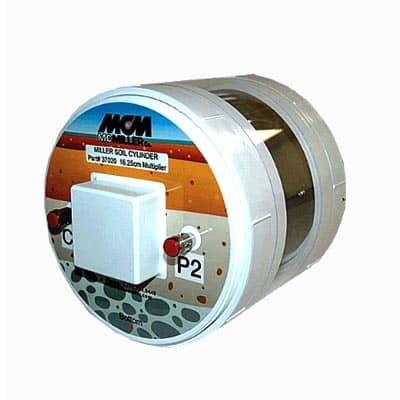
The Soil Cylinder can be used to satisfy either of the 2-electrode methods— ASTM G187 or AASHTO T-288 Standards. The body of the Soil Cylinder is made of clear acrylic (allowing easy viewing of sample) with PVC components and the distribution plates (conducting end plates) are stainless steel. Rubber O-rings provide sealing for the two end caps. Accommodates large sample volumes [approximately 2,714 cm³ (2.714 liters) and can accommodate crushed-rock samples, as well as regular soils and liquids. Water can be added in-situ for sample saturation (de-ionized water, simulated rain water etc.) Provides closed, air-tight volume— field-collected samples can be immediately "installed" in the cylinder, as opposed to filling a separate container for transportation. This means that resistance readings taken at a later stage will be representative of the "as-found" condition of the sample.
Resistivity testing equipment is used to measure the electrical resistance of soil. This test is important for designing earthing systems, assessing corrosion risk, and conducting geotechnical and geophysical investigations.