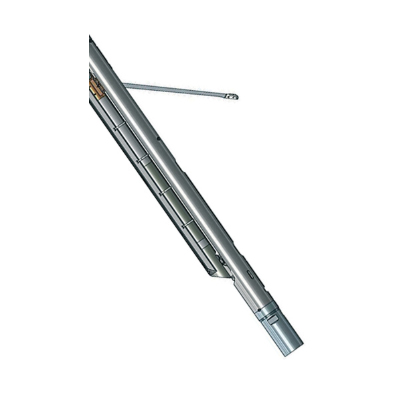
Litho-Density (GLD)

Litho-Density (GLD)

Principle of Measurement: Gamma radiation from a 137Cs source in the tool is Compton scattered by the formation and detected by two scintillation detectors. The relative intensities of the radiation at each detector give a measurement of formation bulk density. The photoelectric measurement is derived from the ratio of the gamma intensities in high and low energy windows at a detector. It depends of the formation atomic number and is a good lithology indicator. The measurements are influenced by the borehole environment. These effects are minimised by corrections calculated by extensive Monte Carlo modelling and benchmarked to standards at the Callisto facility in Leicestershire, UK.
  • Highlights
  • Features
  • Specification
  • Models
  • Standards
  • Review (2)

Litho-Density (GLD) Price in Bangladesh

Litho-Density (GLD) is a professional formation evaluation instrument, and this Litho-Density (GLD) Price in Bangladesh page provides useful information for professionals seeking dependable density logging equipment. Designed to support formation density and lithology analysis, the tool helps geoscientists and well logging engineers evaluate subsurface properties and improve geological interpretation.

The instrument uses advanced density logging technology to measure formation characteristics and provide valuable information about lithology, porosity, and reservoir conditions. Reliable density data can help professionals distinguish different formation types, evaluate rock properties, and support more accurate interpretation of subsurface structures.

Litho-Density (GLD) is suitable for petroleum exploration, geological investigation, reservoir characterization, formation evaluation, and professional borehole logging applications. Its measurement capabilities can be combined with other well logging data to develop a more comprehensive understanding of formation composition and fluid bearing zones.

Designed for demanding field environments, the tool emphasizes dependable performance, measurement stability, and durable construction. Its robust design helps it withstand the operational challenges associated with borehole deployment while supporting consistent data collection during professional logging activities.

For oil and gas companies, drilling contractors, geological survey teams, and well logging service providers, Litho-Density (GLD) can be a valuable addition to a modern formation evaluation system. By providing reliable density and lithology information, it supports better subsurface interpretation and helps professionals make informed decisions during exploration, drilling, and reservoir assessment projects.


SPECIFICATION: The Litho-Density module combines a borehole-corrected bulk density measurement with a photoelectric lithology log (Pe). The radioactive source and detectors are mounted in an articulated skid that is maintained in contact with the borehole wall by a powered backup arm to minimise borehole rugosity effects. The arm also doubles as a caliper measurement. The tool may be combined with compensated neutron and focused induction measurements in the classic ‘triple-combo’ configuration. Principle of Measurement: Gamma radiation from a 137Cs source in the tool is Compton scattered by the formation and detected by two scintillation detectors. The relative intensities of the radiation at each detector give a measurement of formation bulk density. The photoelectric measurement is derived from the ratio of the gamma intensities in high and low energy windows at a detector. It depends of the formation atomic number and is a good lithology indicator. The measurements are influenced by the borehole environment. These effects are minimised by corrections calculated by extensive Monte Carlo modelling and benchmarked to standards at the Callisto facility in Leicestershire, UK. Example of logging data Litho-Density Module Source 3.23m (127”) HRD LSD Caliper Features Drift eliminated by digital circuitry and active calibration loops based on internal reference sources Well characterised tool response based on computer calculations Tungsten carbide coated wear plate on skid can be replaced in the field High-resolution measurement Maximum data sampling rate is 1cm (0.4”) Measurements Bulk density (rhoB) Correction indicator (Δrho) Photoelectric effect (pef) Borehole Diameter Applications Matrix Identification Formation fluid analysis Porosity from density Operating Conditions Borehole type: open hole 4” to 12” Specifications (HRD; LSD) density sensors offsets 160 mm (6.3”) , 399 mm (15.7”) Diameter: 84mm (with stand-off), 74mm (without stand-off) Length: 3.23m (127”) Weight: 57kg (125.6lb) Max. temperature: 125°C Max. pressure: 86MPa (12,500psi) Density range: 1.1 -2.95 g/cc +/- 0.005 g/cc (1 std deviation) Density radius of investigation: 102 mm (4”) to 152 mm (6”) Photoelectric range: 1-10 Barns Caliper range: 90mm (3.54”) – 300mm (12”) Caliper resolution: 1 mm (0.04”) Part Numbers I003937 Litho-Density module Accessories: I013961 18.5GBq 137Cs source I004126 Source holder I004125 Source transport pig I004123 Source handling tool set I004129 Density/ Pe calibrator I004131 Caliper calibrator

2 Reviews For win Your Friends

Add Your Review

Your Rating:
Steven Rich – Sep 17, 2016:
How all this mistaken idea of denouncing pleasure and praising pain was born and I will give you a complete account of the system, and expound the actual teachings.
William Cobus – Aug 21, 2016:
There anyone who loves or pursues or desires to obtain pain itself, because it is pain sed, because occasionally circumstances occur some great pleasure.

Any question about the Litho-Density (GLD) ?

* indicates required fields

CAPTCHA


QC LAB SOLUTION

  Usually Replies Instantly!

Hello! How Can We Help You Today? Choose a question below to chat with us on WhatsApp.

Chat on WhatsApp

QC Lab Solution