
Mechanical Testing Laboratory in Bangladesh – Advanced Material Performance Testing by QC LAB SOLUTION
A Mechanical Testing Laboratory is one of the most important facilities for evaluating the strength, durability, flexibility, and performance of materials used across industries. Mechanical testing provides reliable data that helps manufacturers, engineers, consultants, contractors, and quality professionals make informed decisions regarding product quality and compliance with technical standards.
At QC LAB SOLUTION Bangladesh, Mechanical Testing Laboratory solutions are developed to support industries with accurate testing, laboratory setup, equipment consultation, installation, commissioning, and quality control services. Whether supporting construction materials, geotextiles, technical textiles, industrial products, polymers, or manufacturing applications, mechanical testing helps ensure products meet required specifications and perform consistently under real-world conditions.
What is a Mechanical Testing Laboratory?
A Mechanical Testing Laboratory is a specialized laboratory designed to evaluate how materials respond to external forces and mechanical loads. These tests determine whether a product can withstand tension, compression, puncture, tearing, deformation, or repeated use while maintaining expected performance.
Mechanical testing plays an essential role in:
- Quality Control (QC)
- Quality Assurance (QA)
- Product Validation
- Research and Development (R&D)
- Manufacturing Optimization
- Supplier Qualification
- Product Certification
- Compliance Verification
Laboratory-generated mechanical data helps improve production efficiency, reduce failure risk, and maintain customer confidence.
Importance of Mechanical Testing
Mechanical properties directly influence material performance and service life. A properly equipped Mechanical Testing Laboratory helps organizations verify product consistency and avoid unexpected field failures.
Benefits include:
- Improved product reliability
- Reduced manufacturing defects
- Better production control
- Compliance with international standards
- Increased customer satisfaction
- Support for engineering decisions
Industries across Bangladesh increasingly rely on mechanical testing to meet project specifications and international quality expectations.
Mechanical Testing Services
Tensile Strength Testing
Tensile testing measures the force required to stretch a material until failure. It is one of the most common mechanical tests and provides critical information regarding material strength and elongation characteristics.
Applications:
- Geotextile
- Textile
- Plastic products
- Technical fabrics
- Industrial sheets
- Composite materials
Benefits:
- Measures load-bearing capacity
- Evaluates product durability
- Supports specification compliance
Common standards:
- ASTM
- ISO
- EN
Elongation Testing
Elongation testing determines how much a material can stretch before breaking. This property helps evaluate flexibility and deformation resistance.
Applications:
- Flexible materials
- Polymer products
- Geosynthetics
- Industrial fabrics
Benefits:
- Determines material flexibility
- Supports performance evaluation
- Helps improve product design
Tear Resistance Testing
Tear resistance testing evaluates a material’s ability to resist propagation after an initial cut or defect.
Applications:
- Technical textile
- Geotextile
- Packaging materials
- Flexible membranes
Benefits:
- Measures resistance to damage
- Improves product durability
- Supports field performance evaluation
Puncture Resistance Testing
Puncture testing determines resistance against localized force applied through a probe or penetrator.
Applications:
- Geotextile
- Protective fabric
- Industrial membrane
- Packaging materials
Benefits:
- Prevents field failures
- Supports durability analysis
- Improves structural reliability
Compression Testing
Compression testing evaluates how materials perform under compressive loading conditions.
Applications:
- Construction materials
- Industrial components
- Engineering products
Benefits:
- Determines structural behavior
- Supports engineering analysis
- Verifies product performance
Burst Strength Testing
Burst testing measures the pressure required to rupture a material.
Applications:
- Fabric
- Flexible products
- Packaging systems
Benefits:
- Evaluates pressure resistance
- Supports product validation
Seam Strength Testing
Seam testing determines the strength of stitched, welded, or joined materials.
Applications:
- Technical textile
- Fabric systems
- Geosynthetics
Benefits:
- Improves assembly quality
- Supports product consistency
Equipment Used in Mechanical Testing Laboratory
A modern Mechanical Testing Laboratory requires reliable and calibrated equipment to generate accurate and repeatable results.
Typical equipment includes:
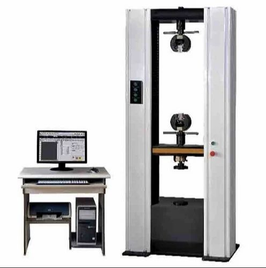
Universal Testing Machine (UTM)
Used for:
- Tensile testing
- Compression testing
- Elongation testing
- Load analysis
Tear Resistance Tester
Used to evaluate tear propagation resistance.
Puncture Resistance Tester
Used for localized force performance testing.
Burst Strength Tester
Used for pressure-related testing.
Digital Thickness Measurement System
Supports dimensional verification.
Sample Preparation Equipment
Ensures standardized specimen preparation.
Environmental Conditioning Chamber
Maintains controlled testing conditions.
Data Acquisition & Analysis Software
Supports reporting and result analysis.