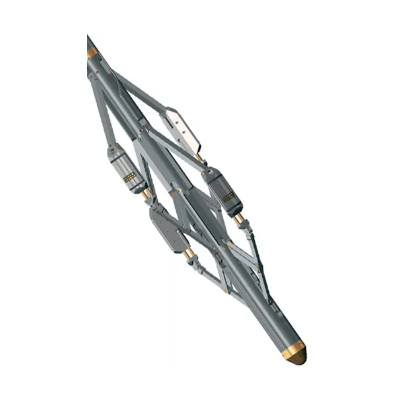
Micro-Resisitivity Imager (GMI)

Micro-Resisitivity Imager (GMI)

The tool includes 4 pads each containing twelve button electrodes mounted on 2 pairs of powered arms. The current emitted by each electrode is focused into a narrow beam and returns to a remote part of the tool body. The current from each electrode is measured and digitised in each pad and transmitted to the surface by a separate telemetry module using a proprietary high-speed communications system. The tool may be run on 7-core cables and is compatible with the standard Robertson Geo oilfield surface system running Warrior™ software.
  • Highlights
  • Features
  • Specification
  • Models
  • Standards
  • Review (2)

Micro-Resisitivity Imager (GMI) Price in Bangladesh

Micro-Resisitivity Imager (GMI) is a specialized geophysical instrument designed for detailed subsurface investigation, and those searching for Micro-Resisitivity Imager (GMI) Price in Bangladesh can explore its applications in geological and formation analysis. It provides valuable resistivity imaging data that helps professionals understand subsurface structures, identify formation variations, and evaluate underground conditions with greater confidence.

Designed for demanding geophysical applications, the Micro-Resisitivity Imager (GMI) supports high-resolution analysis of subsurface formations. Resistivity imaging is widely used to distinguish materials based on their electrical properties, making this technology useful for geological surveys, mineral exploration, environmental investigations, groundwater studies, and borehole-related applications.

The instrument is developed to deliver reliable and detailed measurement results in professional field environments. Its imaging capabilities help users examine variations within formations and identify important geological features that may not be easily detected through conventional investigation methods. This makes it a valuable solution for engineers, geologists, geophysicists, researchers, and exploration professionals.

The Micro-Resisitivity Imager (GMI) can contribute to more efficient subsurface interpretation by providing clear resistivity information for further analysis. Accurate data can support geological modeling, formation evaluation, exploration planning, and decision-making during field investigations. Its professional design also makes it suitable for repeated use in challenging working conditions.

For organizations involved in geophysical exploration and underground investigation, choosing a dependable resistivity imaging system can improve survey efficiency and data quality. The Micro-Resisitivity Imager (GMI) combines specialized imaging technology with practical usability, making it a suitable choice for applications where detailed subsurface information is essential.


The Micro-Resisitivity Imager module provides a high-resolution spatially oriented image of features on the borehole walls. The tool includes 4 pads each containing twelve button electrodes mounted on 2 pairs of powered arms. The current emitted by each electrode is focused into a narrow beam and returns to a remote part of the tool body. The current from each electrode is measured and digitised in each pad and transmitted to the surface by a separate telemetry module using a proprietary high-speed communications system. The tool may be run on 7-core cables and is compatible with the standard Robertson Geo oilfield surface system running Warrior™ software. Example of logging data Micro-Resisitivity Imager Module 3.36m (132”) Imaging Pads Features 48 button electrodes (12 on each pad) Data sampling interval 60ms with real-time transmission of all data Exchangeable pads for hole sizes between 110mm and 220mm 40% wall coverage in 146mm borehole Measurements Micro-resistivity Borehole diameter (XY caliper) Applications Identification of faults and folding Location/characterisation of fractures Determination of structural dips Analysis of sedimentary structures and cross-bedding Core orientation Operating Conditions Borehole type: open-hole, mud/water filled Ø:102mm (4") to 257mm (10.1") Centralisation required Specifications Diameter: 94mm (3.7”) (with 8.5” pad) Length: 3.36m (132”) Weight: 47kg (103.5lb) Max. temperature: 1250C Max. pressure: 86MPa (12,500psi) Caliper accuracy: +/- 5mm Inclination accuracy: +/- 0,1 deg Azimuth accuracy: +/- 5 deg Button current precision: 16-bit (48 button electrodes - 12 on each pad) Resolution (radial & vertical): 7mm (46% wall coverage in 146mm borehole) Logging speed: 300m/hr Borehole range: 114mm (4.5”) to 250mm (10”) Part Numbers I015579 Micro-Resisitivity Imager module

2 Reviews For win Your Friends

Add Your Review

Your Rating:
Steven Rich – Sep 17, 2016:
How all this mistaken idea of denouncing pleasure and praising pain was born and I will give you a complete account of the system, and expound the actual teachings.
William Cobus – Aug 21, 2016:
There anyone who loves or pursues or desires to obtain pain itself, because it is pain sed, because occasionally circumstances occur some great pleasure.

Any question about the Micro-Resisitivity Imager (GMI) ?

* indicates required fields

CAPTCHA


QC LAB SOLUTION

  Usually Replies Instantly!

Hello! How Can We Help You Today? Choose a question below to chat with us on WhatsApp.

Chat on WhatsApp

QC Lab Solution