
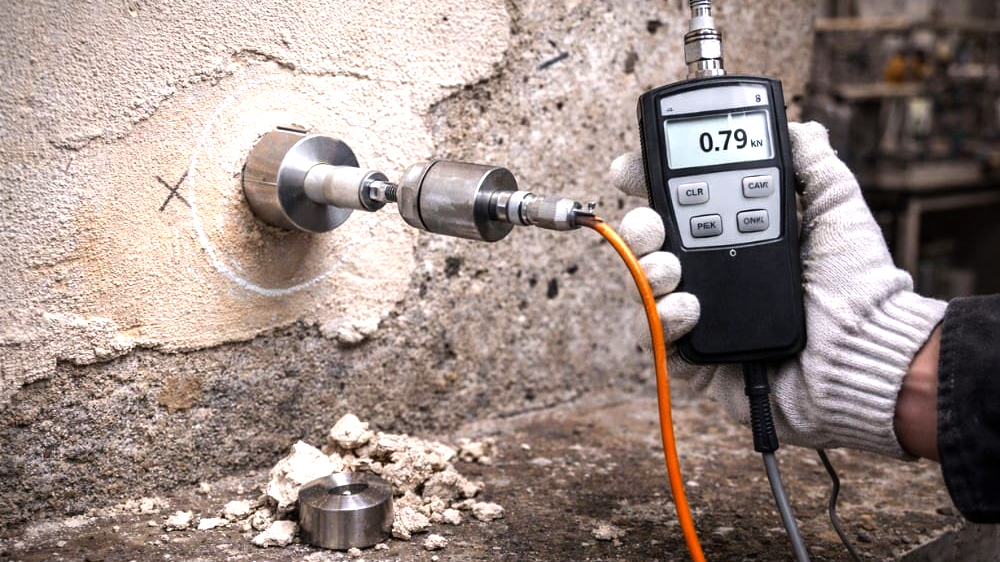
Pull-Off Test in Bangladesh
The Pull-Off Test Service in Bangladesh is an important Structural Non-Destructive Testing (NDT) and condition-assessment technique used to evaluate the tensile strength of concrete surfaces and the adhesion or bond strength of repair, overlay, mortar, coating, and other materials applied to concrete. In construction and structural rehabilitation projects, it is not enough to know the compressive strength of concrete. The quality of the concrete surface and the bond between an existing concrete substrate and a newly applied repair material can have a major influence on the long-term performance of the repaired structure.
For example, a concrete repair mortar may have high compressive strength, but if the bond between the repair material and the original concrete is weak, the repair may crack, debond, delaminate, or eventually detach. Similarly, a protective coating may appear visually satisfactory while having inadequate adhesion to the concrete substrate.
The Pull-Off Test provides a practical way to apply a controlled tensile force perpendicular to the concrete surface and determine the stress at which failure occurs. ASTM C1583/C1583M-25 covers the determination of near-surface tensile strength of concrete and the bond or tensile strength of concrete repair and overlay materials using the pull-off method. The standard is applicable in both field and laboratory environments.
For coating adhesion on concrete, ASTM D7234 is the relevant ASTM method. It uses portable pull-off adhesion testers to determine the perpendicular force required to detach a test area from the concrete/coating system. In Europe, BS EN 1542 specifies pull-off measurement of tensile bond strength for grouts, mortars, concretes, and surface protection systems used for protection and repair of concrete structures.
For projects in Bangladesh involving structural repair, rehabilitation, concrete overlays, waterproofing systems, protective coatings, bridge rehabilitation, industrial floors, and other concrete structures, Pull-Off Testing can provide valuable quantitative information about the condition and performance of the concrete surface and repair system.
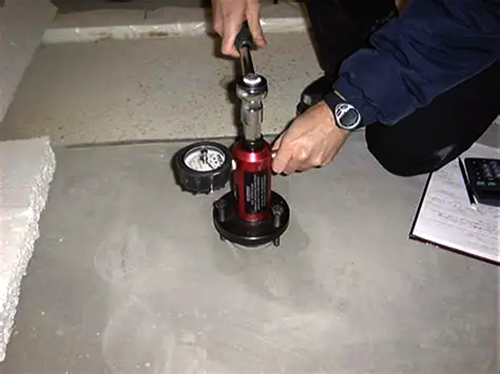
What Is a Pull-Off Test?
A Pull-Off Test measures the tensile stress required to pull a bonded test disc, commonly called a dolly, away from the concrete surface or applied material.
The basic process consists of:
- Selecting the test location.
- Preparing the concrete surface.
- Bonding a steel/aluminium test disc to the surface.
- Cutting or coring around the test area when required by the applicable method.
- Connecting the pull-off testing equipment.
- Applying tensile force perpendicular to the surface.
- Increasing the load until failure occurs.
- Recording the maximum load.
- Identifying the failure location and failure mode.
- Calculating the pull-off tensile stress.
- Reporting the test result together with the failure mode.
ASTM C1583/C1583M-25 specifically describes forming a shallow core into the substrate while leaving the test core attached, bonding a steel disc to the test specimen, and applying tensile load until failure.
The resulting value is generally expressed in:
- MPa
- N/mm²
- psi
The test is called a "pull-off" test because the loading mechanism pulls the bonded disc directly away from the surface.
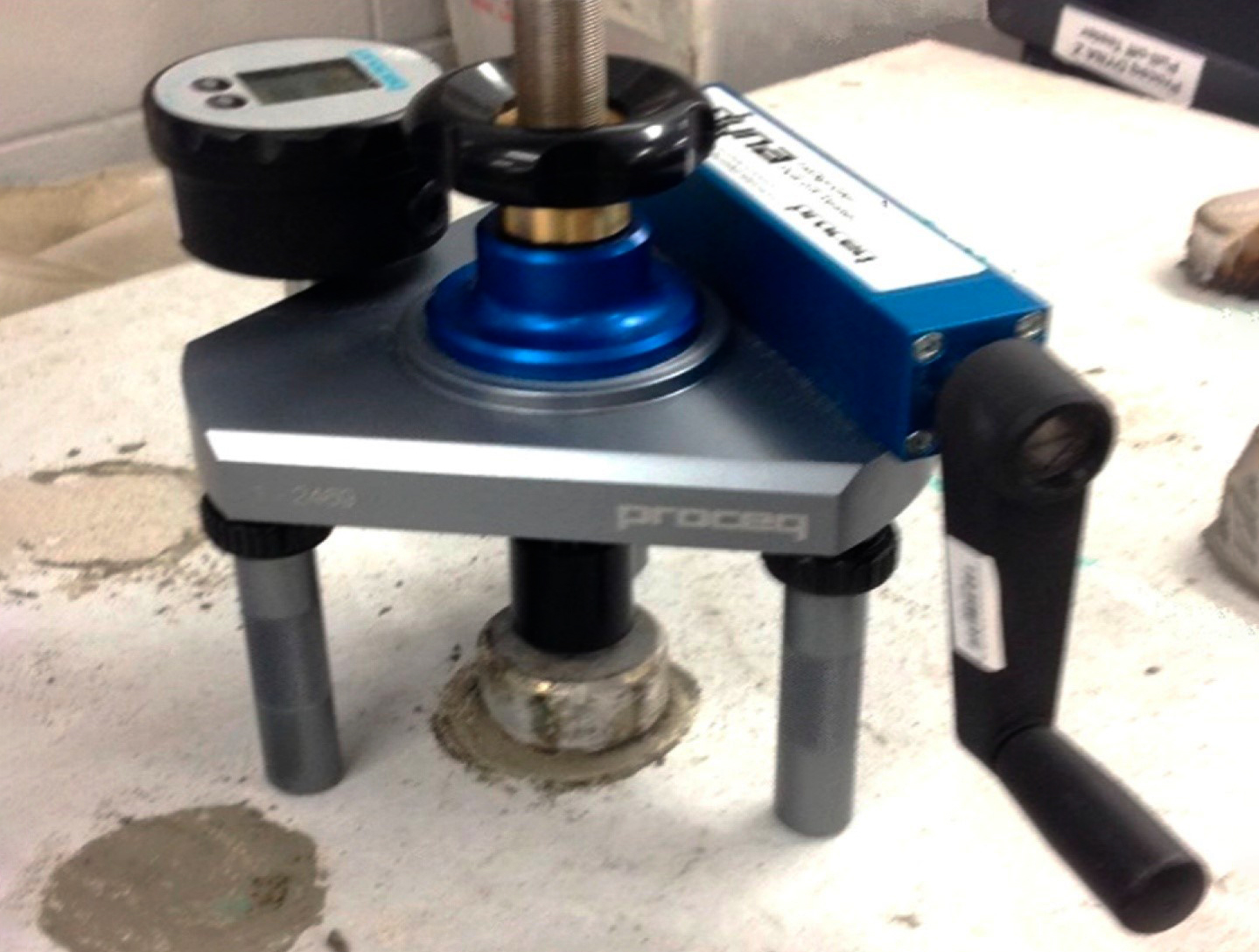
Is Pull-Off Testing Really Non-Destructive?
Pull-Off Testing is generally categorized within structural NDT/condition-assessment programs, but technically it is localized and minimally destructive because the tested area is intentionally taken to failure.
A small test area is affected, and the tested location may require local repair afterward.
Therefore, Pull-Off Testing is better described as a localized direct-tension test used within structural NDT and condition-assessment programs rather than a completely non-damaging inspection technique.
ASTM D7234 specifically notes that pull-off adhesion measurements are destructive and that spot repairs may be necessary.
Relevant Standards for Pull-Off Testing
Several standards may be relevant depending on what is being evaluated.
|
Standard |
Application |
|
ASTM C1583/C1583M-25 |
Tensile strength of concrete surfaces and bond/tensile strength of repair and overlay materials |
|
ASTM D7234-22 |
Pull-off adhesion strength of coatings on concrete |
|
ASTM C1857/C1857M-26 |
Laboratory evaluation of adhesion of concrete repair and overlay mortar |
|
BS EN 1542:1999 |
Pull-off bond strength of concrete protection and repair products |
ASTM C1583/C1583M-25 is currently listed by ASTM as the active edition for direct-tension pull-off testing of concrete surfaces and repair/overlay materials.
ASTM C1857/C1857M-26 is a newer laboratory test method for evaluating adhesion of concrete repair and overlay mortar. ASTM states that this method is designed for laboratory evaluation and standardized comparison rather than determining field bond strength directly.
BS EN 1542 covers measurement of tensile bond strength of grouts, mortars, concretes and surface protection systems used for concrete protection and repair.
The applicable standard should therefore be selected according to the material and purpose of the investigation.
Why Is the Pull-Off Test Important?
1. Evaluating Concrete Surface Quality
Before applying a repair material, engineers need to know whether the existing concrete surface is sufficiently sound.
Weak, deteriorated, contaminated, or poorly prepared concrete can produce a low tensile surface strength.
Pull-Off Testing provides a quantitative measurement rather than relying only on visual inspection.
ASTM C1583/C1583M-25 identifies near-surface tensile strength as an indicator of the adequacy of surface preparation before applying repair or overlay materials.
2. Evaluating Bond Strength
A repair material must develop adequate adhesion with the existing substrate. Pull-Off Testing can determine the strength of the repair-to-concrete interface or identify whether failure occurs elsewhere in the system.
This is particularly useful for:
- Concrete repair mortar
- Polymer-modified repair materials
- Cementitious overlays
- Epoxy systems
- Bonding agents
- Protective systems
- Waterproofing systems
- Floor coatings
3. Quality Control of Repair Work
Pull-Off Testing can be performed after repair work to verify whether the installed system has achieved the specified bond performance. This is particularly valuable for major rehabilitation projects.
4. Detecting Weak Zones
Different areas of a concrete structure may have different surface conditions. Pull-Off testing at selected locations can identify areas where surface tensile strength is significantly lower than expected.
5. Evaluating Surface Preparation
Concrete surfaces may be prepared by:
- Grinding
- Shot blasting
- Scarifying
- Sand blasting
- Water jetting
- Mechanical preparation
The Pull-Off Test can help verify whether the resulting surface is suitable for the subsequent repair or coating system.
Principle of Pull-Off Testing
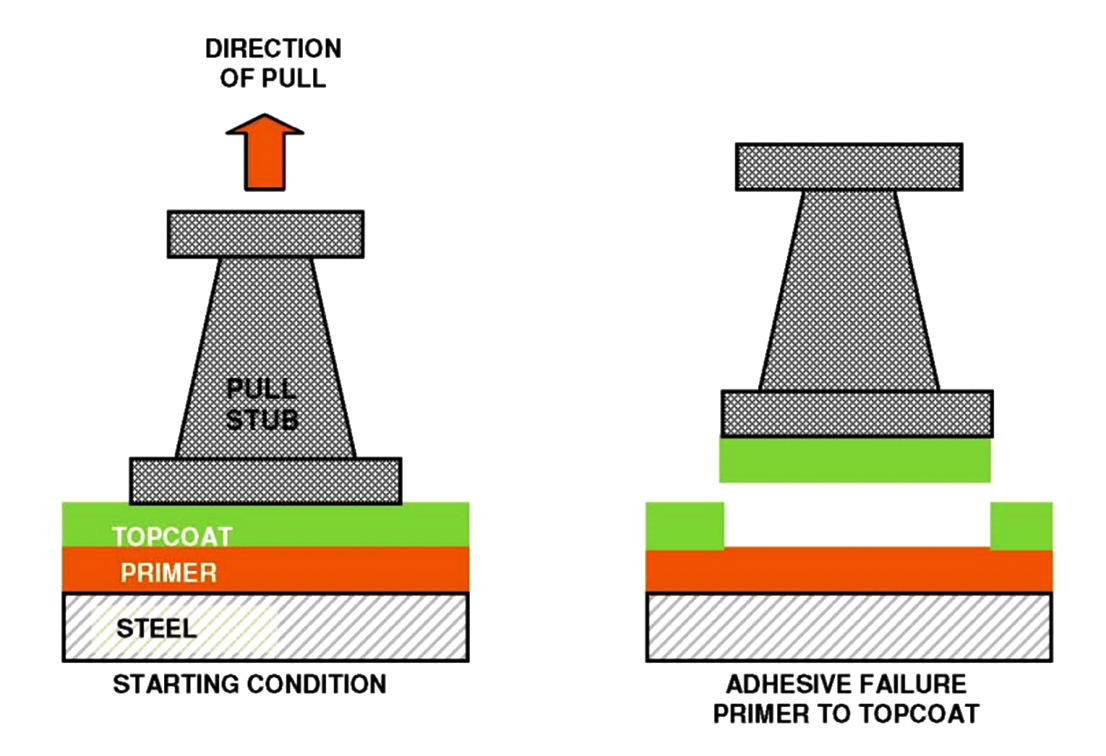
The fundamental principle is direct tensile loading. A circular metal disc is bonded to the surface using a suitable adhesive. The testing device applies an increasing tensile force perpendicular to the surface. At a certain load, failure occurs.
The pull-off stress can be calculated using:
σ=PA
Where:
- σ = pull-off tensile stress
- P = maximum pull-off force
- A = loaded test area
For a circular test area:
A=πd24
Where:
- d = diameter of the test area
Therefore:
σ=4Pπd2
The result is normally reported in MPa or N/mm².
However, the numerical strength alone is not sufficient. The location and mode of failure must also be recorded.
ASTM C1583/C1583M-25 emphasizes that the measured result is controlled by the weakest failure mechanism, so the failure mode must be reported for each individual test.
Failure Modes in Pull-Off Testing
Failure mode is one of the most important parts of a Pull-Off Test report. Typical failure locations can include:
1. Concrete Cohesive Failure
Failure occurs within the concrete substrate. This can indicate that the concrete near the surface is weaker than the repair or adhesive bond.
2. Interface Failure
Failure occurs at the interface between the repair material and existing concrete. This can indicate inadequate adhesion or inadequate surface preparation.
3. Repair Material Failure
Failure occurs within the repair or overlay material itself. The repair material may be weaker in tension than its bond to the substrate.
4. Adhesive Failure
Failure occurs between the test disc and the material being tested. This may indicate that the adhesive bond or test setup was weaker than the material under investigation.
5. Mixed Failure
Failure occurs through more than one material/interface. The report should document the observed failure pattern. The weakest plane controls the measured result, which is why failure mode must accompany the numerical result.

Pull-Off Test Equipment
A typical Pull-Off Testing system consists of:
1. Pull-Off Tester
The main loading device applies a controlled tensile force. Depending on the equipment, the system may be:
- Mechanical
- Hydraulic
- Digital
- Electronic
- Manual
- Automated
2. Loading Dolly
A circular steel or metal disc is attached to the test surface.
3. Adhesive
A suitable high-strength adhesive is used to bond the dolly to the test surface.
4. Core Drill
For methods requiring a defined test area, a core drill is used to isolate the test zone. ASTM C1583/C1583M-25 specifically identifies the core drill, core barrel, steel disc, tensile loading device, and coupling device as apparatus used for the method.
5. Coupling Device
Connects the dolly to the pull-off tester.
6. Surface Preparation Tools
These may include:
- Grinder
- Abrasive tools
- Cleaning equipment
- Wire brush
- Dust removal equipment
7. Measuring and Recording Equipment
Depending on the system:
- Digital display
- Load indicator
- Displacement indicator
- Data logger
- Test report software
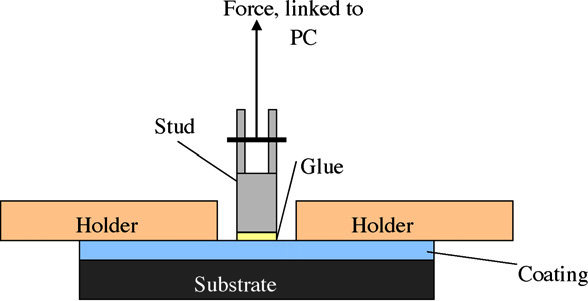
Pull-Off Test Working Procedure
Step 1 – Review Project Requirements
Before testing, QC LAB SOLUTION reviews:
- Structural drawings
- Repair specifications
- Concrete age
- Repair material
- Coating system
- Required test standard
- Acceptance criteria
- Test locations
- Environmental conditions
The acceptance criterion should come from the applicable project specification or material/system specification rather than being invented by the testing agency.
Step 2 – Select Test Locations
Representative locations are selected based on:
- Structural importance
- Repair areas
- Visible deterioration
- Different surface conditions
- Different repair materials
- Coating areas
- Engineer's requirements
The test locations should be properly documented.
Step 3 – Prepare the Surface
Loose particles, dust, weak material, dirt, laitance, or contaminants are removed as required. Surface preparation must be appropriate for the test objective. The preparation should not unnecessarily alter the actual condition being evaluated.
Step 4 – Mark the Test Area
The test position is marked and the test dolly diam eter is established. The location should be photographed before testing where appropriate.
Step 5 – Drill/Cut Around the Test Area
Where required by the applicable method, a shallow circular core is created around the test area. The purpose is to isolate the test section and provide a defined failure area. For ASTM C1583/C1583M-25, the test specimen is formed by drilling a shallow core perpendicular to the surface while leaving the core attached to the substrate.
Step 6 – Clean the Surface
Dust and loose particles are removed. The surface must be suitable for bonding the dolly.
Step 7 – Bond the Dolly
The test disc is bonded to the prepared surface using the specified adhesive. The adhesive must be allowed to develop adequate strength before testing.
Step 8 – Connect the Pull-Off Tester
After the adhesive has adequately cured:
- Attach the coupling assembly.
- Align the loading system.
- Ensure the load is applied perpendicular to the surface.
- Check the equipment condition.
- Zero the instrument where applicable.
Step 9 – Apply Tensile Load
The tensile force is increased progressively. The operator should maintain the required loading procedure specified by the selected standard.
Step 10 – Record Failure Load
The maximum load at failure is recorded. The equipment may display:
- Maximum force
- Pull-off strength
- Load
- Test number
- Sometimes failure data or test curves
Step 11 – Examine Failure Surface
After failure, the operator examines the exposed surface. The failure location is recorded as:
- Concrete
- Repair material
- Interface
- Adhesive
- Mixed failure
Photographs can be taken for documentation.
Step 12 – Calculate Pull-Off Strength
The measured load is converted to tensile stress using the effective test area.
σ=PA
The calculated value is compared with the project requirement or applicable specification.
Example Calculation
Suppose:
- Dolly/test diameter = 50 mm
- Failure load = 4.0 kN
Test area:
A=π5024
A=1963.5 mm2
Failure load:
P=4000 N
Therefore:
σ=40001963.5
σ≈2.04 MPa
The measured pull-off stress is approximately:
2.04 MPa
However, the result should not be interpreted solely from this number. The failure mode and applicable project acceptance requirement must also be considered.
Pull-Off Test for Concrete Repair
Concrete repair is one of the most important applications of this method. During structural rehabilitation, the existing concrete may be repaired using:
- Repair mortar
- Polymer-modified mortar
- Epoxy mortar
- Cementitious overlay
- Shotcrete
- Bonding agents
- Protective coating systems
The new material must develop adequate adhesion to the existing concrete.
A Pull-Off Test can determine whether failure occurs:
Within the concrete → within the repair → at the interface → or at another weak plane.
This makes the method particularly useful for repair quality control.
ASTM C1583/C1583M-25 specifically includes bond strength of concrete repair and overlay materials within its scope.
Pull-Off Test for Concrete Coatings
Protective coatings are frequently applied to:
- Bridges
- Parking structures
- Industrial floors
- Water treatment facilities
- Chemical facilities
- Tanks
- Marine structures
- Concrete buildings
A coating can fail even when the concrete underneath is structurally sound.
Common problems include:
- Poor surface preparation
- Dust
- Oil contamination
- Excess moisture
- Incompatible coating
- Poor curing
- Weak substrate
- Improper application
ASTM D7234 is specifically intended for evaluating pull-off adhesion strength of coatings on concrete using portable pull-off adhesion testers.
Pull-Off Test for Concrete Surface Preparation
Surface preparation is a critical stage in concrete repair. The concrete surface may contain:
- Cement laitance
- Weak concrete
- Dust
- Carbonated material
- Oil
- Paint
- Previous coating
- Contaminants
- Loose particles
A visually clean surface does not necessarily mean that the near-surface concrete has sufficient tensile strength. Pull-Off Testing provides quantitative evidence that can help engineers evaluate the prepared surface.
ASTM C1583/C1583M-25 identifies near-surface tensile strength as an indicator of surface preparation adequacy.

Applications of Pull-Off Testing
Pull-Off Testing can be used for:
Structural Concrete
- Concrete buildings
- Bridges
- Flyovers
- Viaducts
- Parking structures
- Industrial buildings
- Concrete tanks
- Retaining structures
Repair and Rehabilitation
- Concrete repair
- Patch repair
- Overlay systems
- Repair mortars
- Bonding agents
- Rehabilitation projects
Protective Systems
- Epoxy coatings
- Polyurethane coatings
- Cementitious coatings
- Waterproofing systems
- Protective surface treatments
Infrastructure
- Roads
- Bridges
- Airports
- Ports
- Water treatment plants
- Drainage structures
Industrial Facilities
- Factory floors
- Warehouses
- Processing plants
- Chemical facilities
- Power plants
Pull-Off Test vs Rebound Hammer vs UPV
Pull-Off Testing, Rebound Hammer and UPV answer different engineering questions.
|
Method |
Primary Information |
|
Pull-Off Test |
Surface tensile strength / bond strength |
|
Rebound Hammer |
Surface hardness and relative concrete uniformity |
|
UPV |
Ultrasonic pulse transmission and internal concrete condition |
|
Core Test |
Direct compressive strength of extracted concrete |
|
Cover Meter |
Reinforcement location and concrete cover |
|
GPR |
Internal features, reinforcement and anomalies |
Therefore, Pull-Off Testing should not be considered a replacement for Rebound Hammer or UPV. A comprehensive structural investigation may combine several methods. For example:
Visual Inspection + Rebound Hammer + UPV + Cover Meter + Pull-Off Test + Core Test
can provide substantially more information than relying on a single NDT technique.
Advantages of Pull-Off Testing
1. Quantitative Result
The test produces a numerical tensile or bond strength value.
2. Direct Tensile Assessment
Unlike indirect visual inspection, the test applies direct tensile loading.
3. Suitable for Field Testing
Portable pull-off equipment can be used on existing structures.
4. Useful for Repair Quality Control
It can verify the performance of repair and overlay systems.
5. Useful for Coatings
It can evaluate coating adhesion on concrete when the appropriate standard is used.
6. Helps Evaluate Surface Preparation
The method can provide evidence regarding near-surface tensile strength.
7. Localized Testing
Individual areas can be investigated without requiring large-scale removal of the structure.
Limitations of Pull-Off Testing
Pull-Off Testing also has important limitations.
1. Localized Damage
The tested location is taken to failure and may require repair.
2. Failure Mode Matters
A numerical result without the failure mode may be misleading.
3. Surface Preparation Can Affect Results
Grinding, cleaning, moisture, contamination and other preparation conditions can influence the measurement.
4. Adhesive Performance Matters
If the adhesive bond fails before the material under investigation, the result may represent the adhesive system rather than the substrate or coating.
5. Small Test Area
The result represents a localized area and may not represent the entire structure.
6. Moisture and Environmental Conditions
Surface moisture and environmental conditions can influence bonding and testing.
7. Not a Compressive Strength Test
Pull-Off strength should not be directly substituted for concrete compressive strength.
8. Acceptance Criteria Are Project Specific
There is no universal pull-off value that automatically applies to every structure, repair material, coating, or application. The appropriate specification, material manufacturer's requirements, design documents, and applicable standard should be considered.
Quality Assurance and Quality Control
For reliable Pull-Off Testing, QC LAB SOLUTION should maintain a controlled QA/QC process.
Equipment Verification
The pull-off tester should be maintained and checked according to manufacturer and project requirements.
Correct Dolly Size
The appropriate loading fixture and test area should be used according to the selected method.
Surface Preparation Control
Surface preparation should be documented.
Adhesive Control
The adhesive type, mixing, application and curing time should be recorded.
Loading Alignment
The loading system should apply force perpendicular to the test surface as required.
Environmental Conditions
Record:
- Temperature
- Relative humidity
- Surface condition
- Moisture condition where relevant
Failure Mode Documentation
Every test should include the observed failure location.
Photographic Documentation
Photographs of the test area before and after testing can improve report quality.
Test Location Records
Each test should have a unique identification number.
Reporting
The final report should clearly identify:
- Project
- Structure
- Test location
- Date
- Equipment
- Standard
- Test diameter
- Maximum load
- Pull-off strength
- Failure mode
- Environmental conditions
- Photographs
- Remarks
Health and Site Safety
Pull-Off Testing involves drilling, grinding, adhesives, mechanical loading and potentially elevated work areas. Appropriate safety procedures should include:
- PPE
- Safety helmet
- Safety glasses
- Gloves
- Safety shoes
- Dust protection
- Electrical safety
- Safe drilling practices
- Fall protection for elevated structures
- Proper cable management
- Secure equipment positioning
- Sa f e handling of adhesives
- Barricading of test areas
When testing bridges, high-rise structures, industrial plants, tanks or other difficult-access structures, additional access and fall-protection arrangements may be necessary. The applicable test standard should always be reviewed together with the project's safety requirements.
QC LAB SOLUTION Contribution to Pull-Off Testing
QC LAB SOLUTION can provide Pull-Off Testing as part of an integrated structural inspection and NDT program.
Our service approach can include:
1. Project Review
Understanding the structural condition and testing objectives.
2. Test Planning
Selecting representative locations based on the project requirements.
3. Surface Assessment
Reviewing the concrete surface before testing.
4. Pull-Off Testing
Conducting direct tensile pull-off measurements using suitable equipment.
5. Failure Mode Identification
Recording whether failure occurs in:
- Concrete
- Repair material
- Interface
- Adhesive
- Mixed zone
6. Data Processing
Calculating pull-off tensile/bond strength.
7. Photographic Documentation
Recording the test locations and failure surfaces.
8. Technical Reporting
Preparing a structured report containing test results and observations.
9. Integrated NDT
Where required, Pull-Off Testing can be combined with:
- UPV
- Rebound Hammer
- Cover Meter
- GPR
- Half-Cell Potential
- Core Testing
- Visual Inspection
This integrated approach can provide engineers with a more comprehensive understanding of structural condition.
Working Steps on Field
A typical QC LAB SOLUTION Pull-Off Test workflow can be summarized as:
Project Review
↓
Site Inspection
↓
Test Location Selection
↓
Surface Preparation
↓
Core Cutting / Isolation
↓
Dolly Bonding
↓
Adhesive Curing
↓
Tester Installation
↓
Controlled Tensile Loading
↓
Failure
↓
Maximum Load Recording
↓
Failure Mode Identification
↓
Strength Calculation
↓
Photographic Documentation
↓
Engineering Report
Why Choose QC LAB SOLUTION?
A reliable Pull-Off Test depends not only on the testing equipment but also on appropriate test planning, surface preparation, loading procedure, failure-mode identification and reporting.
QC LAB SOLUTION focuses on providing practical structural testing and engineering inspection services with:
- Professional field testing
- Appropriate testing methodology
- Standard-based procedures
- Detailed documentation
- Photographic evidence
- Clear test locations
- Quantitative results
- Integrated structural NDT capability
- Technical reporting
For projects requiring structural rehabilitation or quality verification, Pull-Off Testing can be integrated with other NDT services to provide a more complete picture of concrete condition.
The Pull-Off Test is an important structural assessment technique for determining the near-surface tensile strength of concrete and the bond or adhesion strength of repair, overlay and coating systems. The method works by bonding a test disc to the concrete or applied material and applying a controlled tensile force until failure occurs. The resulting load is converted into tensile or bond stress, while the failure mode is documented.
The current ASTM C1583/C1583M-25 specifically covers tensile strength of concrete surfaces and bond/tensile strength of concrete repair and overlay materials using the direct-tension pull-off method. For coatings on concrete, ASTM D7234 provides the applicable pull-off adhesion method. The greatest value of Pull-Off Testing comes from combining the numerical result with the observed failure mode, test location, surface condition and project acceptance criteria. For structural rehabilitation, concrete repair, protective coatings and quality assurance projects in Bangladesh, Pull-Off Testing can therefore serve as a valuable component of a broader structural NDT and condition-assessment program.