
Standard Penetration Test (SPT) in Bangladesh
The Standard Penetration Test (SPT) is one of the most widely used in-situ geotechnical testing methods for investigating subsurface soil conditions. It is primarily performed during borehole drilling to determine the penetration resistance of soil and to obtain disturbed soil samples for identification and classification. The test is particularly valuable because it provides engineers with direct field information about how soil behaves at different depths rather than relying only on surface observations or laboratory testing.
In Bangladesh, SPT has become an important component of geotechnical investigations for buildings, bridges, roads, industrial facilities, power infrastructure, embankments, ports, transmission lines and other major civil engineering projects. The test is especially useful in a country where subsurface conditions can change significantly over relatively short distances because of variations in alluvial deposits, river sediments, fill materials, soft clay, silty soils, sand layers and groundwater conditions.

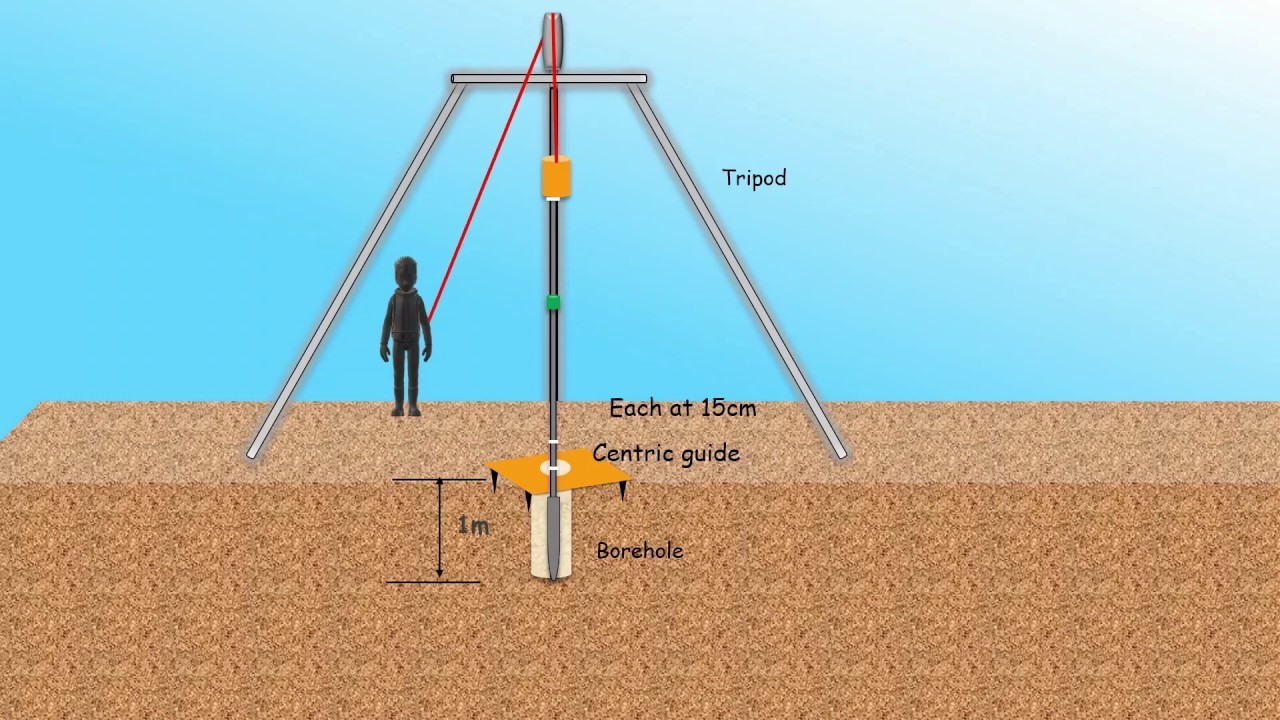
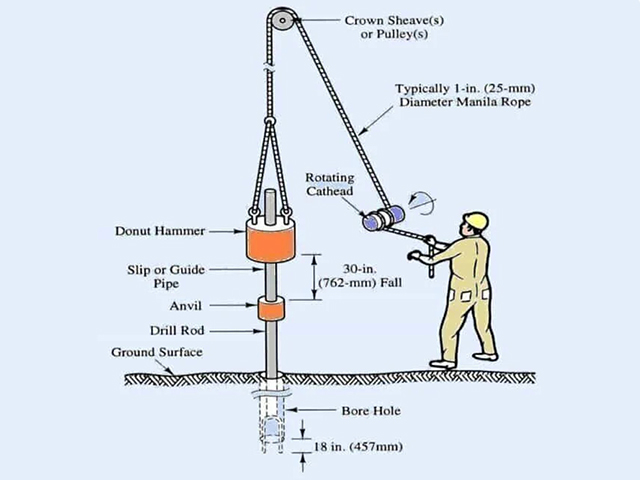
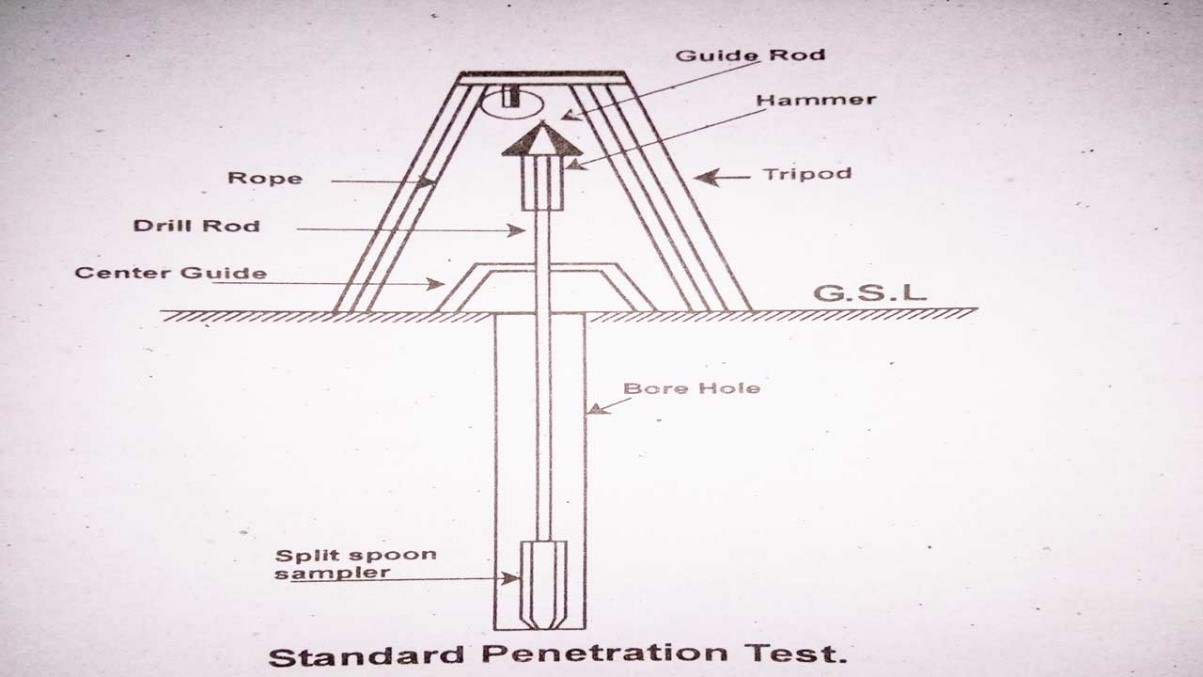
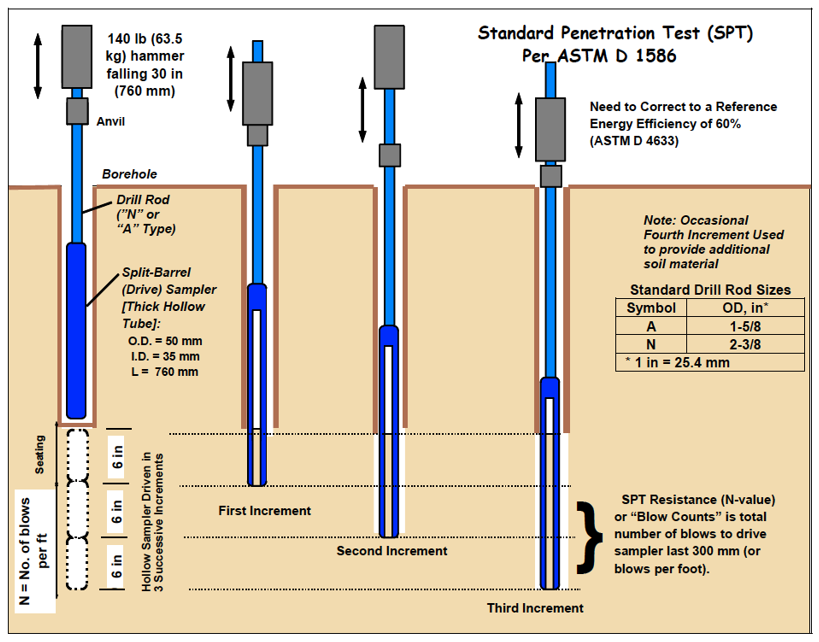
The basic SPT procedure involves driving a standard split-barrel sampler into the soil at the bottom of a borehole using a 63.5 kg (140 lb) hammer falling through approximately 0.76 m (30 in.). The number of hammer blows required for the specified penetration provides the SPT penetration resistance, commonly referred to as the N-value. ASTM D1586/D1586M describes the standard method and identifies the N-value as the number of blows required for the specified 0.15–0.45 m portion of the drive.
The information obtained from SPT can contribute to assessments of soil consistency, relative density, foundation suitability, settlement, bearing capacity and, when properly corrected and combined with other data, seismic liquefaction potential.
For QC LAB SOLUTION, SPT is an important geotechnical investigation service because reliable subsurface information is fundamental to safe and economical foundation design.
What Is the Standard Penetration Test?
The Standard Penetration Test is a dynamic in-situ soil penetration and sampling test conducted inside a borehole.
During the test, a standard split-spoon or split-barrel sampler is positioned at the bottom of a properly prepared borehole. A standardized hammer is then repeatedly dropped from the specified height to drive the sampler into the soil.
The penetration is generally divided into three successive 150 mm increments:
- First 150 mm — seating drive
- Second 150 mm — measured penetration
- Third 150 mm — measured penetration
The number of blows required for the second and third 150 mm increments is added together to obtain the conventional SPT N-value.
For example:
|
Penetration |
Blows |
|
First 150 mm |
5 |
|
Second 150 mm |
8 |
|
Third 150 mm |
12 |
|
SPT N-value |
20 |
Therefore, the N-value is:
N = 8 + 12 = 20 blows/300 mm
The first 150 mm is generally treated as seating penetration and is not included in the standard N-value.
Bangladesh government project documentation also commonly specifies the same basic arrangement, including a 63.5 kg hammer, 0.76 m free fall and recording blows over successive 150 mm intervals.

Market Growth and Industry Trends in Bangladesh:
Bangladesh is experiencing continued development of residential, commercial, industrial and infrastructure projects. As buildings become taller and infrastructure becomes more complex, understanding subsurface conditions becomes increasingly important.
Geotechnical investigation is no longer limited to large high-rise projects. It is routinely required for projects such as:
- High-rise buildings
- Residential developments
- Industrial plants
- Factories
- Warehouses
- Bridges
- Flyovers
- Roads and highways
- Railway infrastructure
- Power plants
- Substations
- Transmission towers
- Ports and terminals
- Water treatment facilities
- Embankments
- Large institutional buildings
- Government infrastructure
The increasing use of deep foundations in difficult soil conditions has also increased the importance of reliable borehole and SPT data.
Government and infrastructure project specifications in Bangladesh frequently incorporate geotechnical investigation, borehole drilling, SPT results, groundwater observations and laboratory soil classification. Recent Bangladesh project documentation, for example, specifies investigations in accordance with relevant ASTM standards and BNBC 2020 and includes SPT results as part of the subsurface investigation process.
Another important trend is the increasing emphasis on data quality rather than simply obtaining an N-value. Modern geotechnical practice recognizes that SPT results can be influenced by hammer energy, drilling method, rod length, borehole condition, sampler configuration and operator practices. ASTM notes that different hammer systems can transfer substantially different amounts of energy to the drill rods, which is why energy correction and N60 values may be important for certain engineering applications.
Consequently, Bangladesh's geotechnical sector is gradually moving toward more systematic field documentation, improved drilling practices, better equipment and integrated interpretation involving SPT, laboratory testing and other investigation techniques.
Why Is SPT So Important?
The foundation of every structure transfers loads to the ground. If the ground is not properly understood, even a well-designed structural system can experience excessive settlement, differential settlement, tilting or other geotechnical problems.
SPT helps engineers understand the subsurface profile by providing field penetration resistance at different depths.
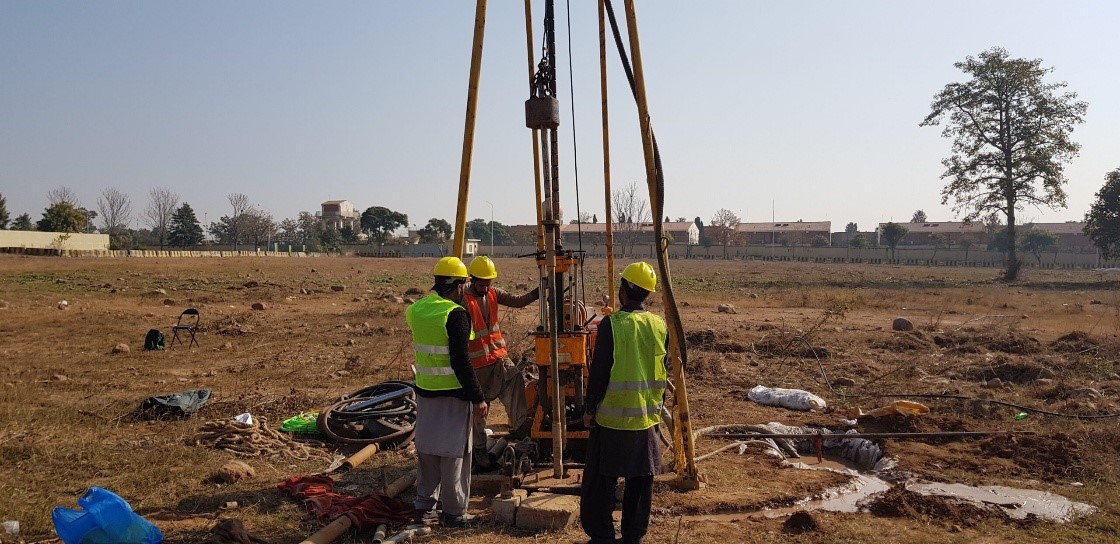
- Understanding Soil Strength and Resista nce
The N-value provides an indication of the resistance of soil to penetration. In granular soils, it is commonly used as an indicator of relative density.
Higher penetration resistance generally indicates denser or more resistant soil, while lower values can indicate looser or softer materials.
However, N-values should not be interpreted in isolation. They must be considered alongside soil type, groundwater conditions, overburden stress, drilling conditions and project requirements.
- Foundation Design
SPT data can be used with appropriate engineering correlations to support assessment of:
- Shallow foundation bearing capacity
- Settlement
- Deep foundation conditions
- Pile design considerations
- Soil stratification
- Relative density of granular deposits
The ASTM standard specifically identifies SPT penetration resistance and associated soil samples as information that can be used for geotechnical design purposes.
- Soil Classification
The split-barrel sampler provides disturbed soil material that can be examined and classified.
The sample can assist in identifying:
- Sand
- Silty sand
- Clayey sand
- Silt
- Clay
- Gravelly materials
- Fill materials
- Organic or unusual materials
SPT therefore combines two useful functions: penetration resistance measurement and disturbed soil sampling.
- Groundwater Assessment
During borehole drilling, the groundwater level can also be observed and recorded.
This is particularly important in Bangladesh because groundwater conditions can influence:
- Soil effective stress
- Foundation behavior
- Excavation
- Basement construction
- Settlement
- Liquefaction assessment
- Dewatering requirements
Key Techniques of Standard Penetration Testing
Although SPT appears straightforward, obtaining dependable results requires proper control of several technical factors.
- Borehole Preparation
The borehole must be advanced to the intended test depth and properly cleaned before the sampler is positioned.
Loose material at the bottom of the borehole can enter the sampler or alter the penetration resistance and therefore affect the test result.
ASTM D1586 emphasizes proper borehole cleaning and recommends appropriate cleanout between test intervals.
- Standard Hammer System
The conventional SPT system uses:
- 63.5 kg hammer
- Approximately 0.76 m free fall
- Standard split-barrel sampler
- Drill rods
- Anvil/drive head
- Guide system
The condition and operation of the hammer system are important because the energy delivered to the sampler affects the measured N-value.
- Blow Count Recording
Field technicians must record the number of blows for each 150 mm penetration interval.
A proper field log should identify:
- Borehole number
- Test depth
- Soil description
- Blow count for each increment
- Total N-value
- Sample recovery
- Groundwater observations
- Refusal or unusual conditions
- Drilling method
- Equipment information
- Energy Consideration and N60
A conventional field N-value is not necessarily equivalent to an energy-normalized N-value.
Modern SPT practice may use N60, which represents an N-value normalized to approximately 60% of the theoretical hammer energy.
ASTM D6066/D6066M-24 provides a method for measuring normalized SPT values for sands and emphasizes energy measurement and controlled hammer/drilling conditions for improved repeatability.
This is particularly important when SPT results from different drilling rigs, hammer systems or projects are compared.
Equipment Used for SPT
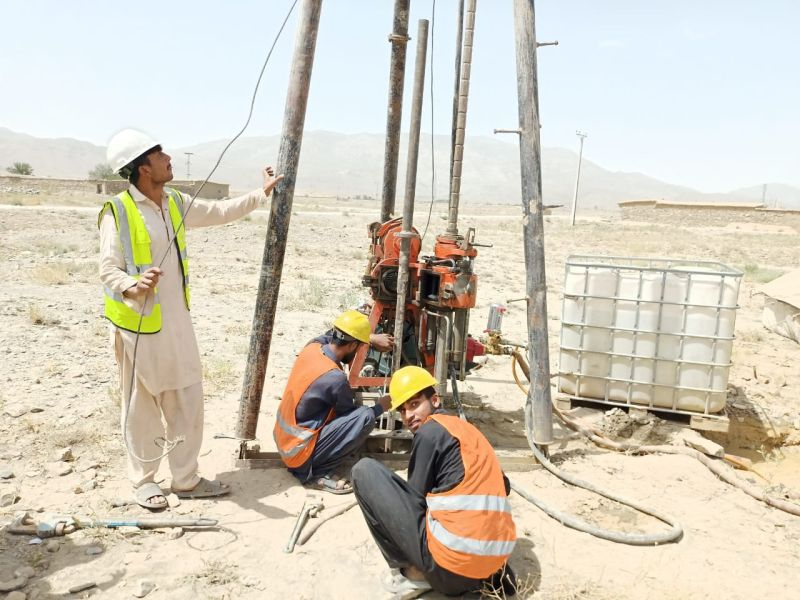
A professional SPT investigation normally requires a combination of drilling and testing equipment.
Major equipment includes:
- Borehole drilling rig
- Drill rods
- Standard split-spoon/split-barrel sampler
- 63.5 kg SPT hammer
- Hammer lifting and dropping mechanism
- Anvil/drive head
- Drilling casing where required
- Water or drilling fluid circulation system
- Sample containers
- Sample labels and field documentation
- Depth measuring equipment
- Groundwater measuring equipment
- Personal protective equipment
- Surveying/location equipment
For advanced quality control, hammer energy measurement and monitoring may also be considered.
Standard Penetration Test Working Procedure
Step 1: Site Preparation
Before drilling starts, the investigation location is identified and marked.
The team confirms:
- Borehole coordinates
- Ground elevation
- Existing structures
- Underground utilities
- Access for drilling equipment
- Safe working area
- Required borehole depth
- Required test intervals
Step 2: Borehole Drilling
The drilling rig advances the borehole to the required test depth.
Depending on the soil and groundwater conditions, different drilling methods and casing arrangements may be required.
The drilling process should be carefully monitored to avoid unnecessary disturbance of the soil.
Step 3: Cleaning the Borehole
Once the required depth is reached, the borehole bottom is cleaned.
This step is critical because accumulated loose soil or drilling debris can produce misleading penetration resistance.
Step 4: Positioning the Sampler
The standard split-barrel sampler is attached to the drill rods and lowered carefully to the bottom of the borehole.
The sampler must be positioned correctly before starting the drive.
Step 5: Seating Drive
The hammer is used to drive the sampler through the first 150 mm.
This is generally considered the seating portion.
The number of blows is recorded because it provides useful field information, even though it is not normally included in the conventional N-value.
Step 6: Measuring the Standard Drive
The sampler is then driven through the next 300 mm.
The number of blows required for each 150 mm increment is recorded separately.
For example:
- 150–300 mm = 10 blows
- 300–450 mm = 15 blows
Therefore:
N = 10 + 15 = 25
Step 7: Sample Recovery
After the drive is completed, the sampler is retrieved.
The recovered soil is examined and transferred to suitable containers or sample bags.
The sample should be properly labeled with information such as:
- Project name
- Borehole number
- Sample number
- Depth
- Date
- Soil description
Step 8: Continue to the Next Test Depth
The borehole is advanced to the next specified SPT depth.
SPT may commonly be performed at approximately 1.5 m intervals or where there is a significant change in soil strata, subject to project specifications and the applicable standard. ASTM D1586 identifies 5 ft (approximately 1.5 m) intervals as typical practice unless otherwise specified.
Working Steps on Field
A professional field operation can be summarized as follows:
Site inspection → Borehole positioning → Drilling → Borehole cleaning → SPT sampler installation → Hammer driving → Blow count recording → Sample recovery → Soil identification → Groundwater observation → Next test depth → Data compilation
At every test location, the field team should maintain accurate records.
A typical field SPT log should contain:
|
Information |
Record |
|
Project |
Project identification |
|
Location |
Borehole coordinates/location |
|
Borehole No. |
BH-01, BH-02 etc. |
|
Ground Level |
Elevation |
|
Test Depth |
Depth of SPT |
|
Soil Layer |
Soil description |
|
1st 150 mm |
Blow count |
|
2nd 150 mm |
Blow count |
|
3rd 150 mm |
Blow count |
|
N-value |
Sum of second + third increments |
|
Sample |
Sample identification |
|
Groundwater |
Water level |
|
Remarks |
Refusal, gravel, disturbance etc. |
This field information subsequently becomes part of the geotechnical investigation report.
Interpretation of SPT N-Values
SPT N-values are frequently used as an indicator of soil resistance, but interpretation depends heavily on soil type and testing conditions.
For granular soils, N-values are often correlated with relative density.
A simplified engineering interpretation may describe soils as progressing from very loose/loose through medium dense and dense to very dense as N-values increase. However, such classifications should not be treated as universal acceptance limits because correlations vary according to soil type, stress level, hammer efficiency and other factors.
For cohesive soils, SPT N-values may sometimes be correlated with consistency or approximate strength, but ASTM specifically cautions that SPT is unreliable for very soft clays and that other methods such as CPT, vane shear testing or high-quality sampling may be more appropriate.
Therefore, professional interpretation should consider:
- Soil type
- N-value
- Depth
- Groundwater
- Overburden stress
- Hammer efficiency
- Borehole condition
- Soil density/consistency
- Laboratory test results
- Geological setting
SPT and Foundation Design
One of the most important applications of SPT in Bangladesh is providing subsurface information for foundation design.
Engineers may use SPT data, together with laboratory testing and appropriate correlations, to assess the suitability of different foundation solutions.
Shallow foundations
For suitable near-surface soils, SPT results can contribute to evaluations of:
- Allowable bearing pressure
- Settlement
- Soil density
- Foundation depth
Deep foundations
Where competent bearing strata are deeper, SPT data can assist with understanding:
- Soil layering
- Dense sand horizons
- Stiff clay layers
- Potential pile-bearing strata
- Shaft resistance conditions
- Construction considerations
The final foundation design should always be performed by the responsible geotechnical/structural engineer using project-specific information rather than relying on an N-value alone.
SPT for Liquefaction Assessment
Liquefaction is an important consideration for certain earthquake-prone soil conditions.
Loose, saturated, predominantly granular soils can be susceptible to strength loss during strong earthquake shaking.
SPT data are widely used in established liquefaction assessment procedures. However, the raw N-value normally requires appropriate corrections and normalization before it is used in a detailed liquefaction analysis.
ASTM D6066/D6066M-24 specifically addresses normalized SPT values for sands and requires controlled procedures and energy measurements to reduce variability.
A proper liquefaction investigation may therefore involve:
- Borehole drilling
- SPT testing
- Soil sampling
- Groundwater measurement
- Grain-size analysis
- Energy normalization
- Overburden correction
- Seismic demand assessment
- Liquefaction triggering analysis
- Engineering interpretation
SPT should therefore be considered part of a broader geotechnical and seismic assessment rather than a standalone liquefaction test.
QC LAB SOLUTION's Contribution to SPT Services
QC LAB SOLUTION provides professional civil engineering and laboratory-related services for projects requiring dependable technical data.
Our contribution to SPT-based geotechnical investigations can include:
Professional Field Investigation
Our technical team can coordinate field investigation activities including borehole drilling, SPT execution, soil sampling and field documentation.
Accurate Field Data
Proper recording of individual blow counts, penetration intervals, depths, soil descriptions and groundwater observations is essential for meaningful interpretation.
Sample Handling
Recovered disturbed soil samples are identified, labeled and preserved for subsequent laboratory examination and testing.
Laboratory Support
Where required, SPT investigations can be combined with laboratory soil testing such as:
- Moisture content
- Grain-size distribution
- Atterberg limits
- Specific gravity
- Soil classification
- Density-related testing
- Consolidation testing
- Shear strength testing
- Other project-specific geotechnical tests
Geotechnical Reporting Support
Field results can be compiled into borehole logs and investigation reports containing:
- Borehole profiles
- SPT N-values
- Soil descriptions
- Groundwater information
- Laboratory test results
- Soil stratification
- Engineering observations
The objective is to transform field observations into organized engineering information that can support project decision-making.
Targeted Customers for SPT Services
SPT services are relevant to a wide range of organizations.
Government Organizations
Government agencies frequently require geotechnical investigations for:
- Roads
- Bridges
- Government buildings
- Power infrastructure
- Water infrastructure
- Railway projects
- Public facilities
- Industrial development
Real Estate Developers
Developers of multi-storey and high-rise buildings require reliable subsurface information before finalizing foundation design.
Construction Companies
Contractors can use geotechnical investigation data to understand the expected ground conditions and construction risks.
Engineering Consultants
Consultants use SPT and laboratory data as inputs for geotechnical analysis and foundation recommendations.
Industrial Organizations
Factories, warehouses, manufacturing facilities and utility structures require soil investigations before construction.
Infrastructure Developers
Major infrastructure projects such as bridges, highways, transmission lines, substations and power facilities may require extensive borehole and SPT programs.
Advantages and Benefits of SPT
-
- Direct In-Situ Measurement
SPT measures soil penetration resistance directly in the ground.
-
- Soil Sample Collection
The test simultaneously provides disturbed samples that can be used for identification and classification.
-
- Widely Recognized Method
SPT is an internationally recognized geotechnical investigation technique. ASTM describes it as one of the most frequently used subsurface exploration drilling tests worldwide.
-
- Useful for Foundation Investigation
SPT data can contribute significantly to foundation-related assessments.
-
- Suitable for Many Soil Types
The method can be applied to a wide range of non-lithified soils, although its suitability varies with soil conditions.
-
- Cost-Effective
Compared with some advanced in-situ investigation methods, SPT can provide both penetration resistance and a physical soil sample during conventional borehole drilling.
-
- Supports Geological Understanding
Repeated SPT testing at different depths helps establish the subsurface soil profile.
Quality Assurance and Quality Control
Quality assurance is one of the most important aspects of SPT.
A numerical N-value is only useful when the test has been performed correctly.
Key QA/QC considerations include:
Equipment inspection: Hammer, rods, sampler and related components should be checked before testing.
Hammer operation: The hammer drop system must be properly maintained and operated.
Borehole cleaning: The borehole must be adequately cleaned before testing.
Correct test depth: The actual test depth should be recorded accurately.
Blow counting: Each penetration interval must be recorded separately.
Sampler condition: The sampler should be checked for damage, blockage or abnormal wear.
Groundwater recording: Water levels should be measured and documented where applicable.
Sample identification: Every sample must have an unambiguous identification.
Field documentation: Abnormal conditions such as refusal, gravel obstruction or sampler blockage should be recorded.
ASTM highlights that SPT N-values can be affected by multiple variables, including hammer energy and drilling practices. Therefore, simply reporting an N- value without documenting the testing conditions can reduce the usefulness of the data.
For specialized projects, energy-normalized testing may be appropriate. ASTM D6066 requires energy measurements and controlled conditions when obtaining normalized SPT resistance for sands.
Site and Health Safety During SPT
SPT fieldwork involves heavy machinery, rotating drilling equipment, suspended loads, moving drill rods and high-energy hammer operations.
Therefore, safety must be incorporated into every stage of the investigation.
Major safety measures include:
- Use appropriate PPE.
- Establish a controlled drilling zone.
- Keep unauthorized personnel away from operating equipment.
- Inspect lifting equipment.
- Maintain safe distances from rotating components.
- Never place hands near moving drill rods.
- Secure loose clothing and equipment.
- Use appropriate lifting procedures for heavy components.
- Maintain stable drilling-rig positioning.
- Manage drilling water and mud safely.
- Control electrical hazards.
- Maintain adequate lighting for night operations.
- Identify underground utilities before drilling.
- Provide emergency response arrangements.
- Stop operations during unsafe site conditions.
ASTM also makes clear that the SPT standard itself does not cover every aspect of site safety and that users are responsible for establishing appropriate safety and health practices.
For Bangladesh projects, the project-specific safety plan, client requirements and applicable occupational health and safety requirements should also be followed.
Common Challenges of SPT in Bangladesh
Bangladesh's complex geological and environmental conditions can create challenges during SPT operations.
Soft Clay
Very soft clay may produce unreliable SPT results because the soil can deform under the weight of the rods and hammer system before the intended test drive. ASTM specifically identifies this limitation.
Loose Saturated Sand
Loose sand below the groundwater table can create borehole stability and sampling problems.
Gravel and Cobbles
Large particles can cause very high blow counts or refusal and may produce misleading results.
ASTM notes that gravel, cobbles and boulders can lead to penetration refusal and unreliable N-values.
Groundwater
Groundwater can influence drilling conditions and soil behavior.
Equipment Variability
Different hammer systems can deliver different energy levels.
Operator Dependence
Improper hammer operation, inconsistent drop height or incorrect blow counting can affect the results.
These challenges demonstrate why SPT should be conducted by an experienced field team using appropriate equipment and documentation procedures.
SPT Compared With Other Geotechnical Investigation Methods
SPT is extremely useful, but it is not the only geotechnical investigation technique.
Depending on project requirements, engineers may also consider:
- Cone Penetration Test (CPT)
- Dynamic Cone Penetration Test
- Plate Load Test
- Field Vane Shear Test
- Pressuremeter Test
- Borehole logging
- Geophysical investigation
- Laboratory soil testing
- Undisturbed sampling
For example, CPT can provide more continuous penetration data, while high-quality undisturbed sampling can be more appropriate for certain soft cohesive soils.
The best investigation program depends on the geological environment, project type, foundation system and engineering questions that need to be answered.
Standards and Technical References
SPT investigations may be conducted according to the standard specified by the project or client.
Important references include:
ASTM D1586/D1586M
Standard Test Method for Standard Penetration Test (SPT) and Split-Barrel Sampling of Soils.
It defines the conventional SPT procedure, including the hammer, sampler, penetration and N-value methodology.
ASTM D6066/D6066M
Standard Test Method for Measuring Normalized Standard Penetration Test (SPT) Value, N60, of Sands.
It addresses normalization of SPT resistance and energy-related considerations for sands.
BS EN ISO 22476-3
This is another internationally recognized reference for SPT procedures. A Bangladesh government development survey document identifies SPT procedures with reference to BS EN ISO 22476-3 and ASTM D1586.
BNBC 2020
For Bangladesh projects, the applicable provisions of the Bangladesh National Building Code (BNBC 2020) and project-specific specifications should be considered alongside the selected testing standard.
The actual governing standard should always be confirmed from the project specification, consultant requirements and applicable regulatory documents.
Future of SPT and Geotechnical Services in Bangladesh
The future demand for geotechnical investigation services in Bangladesh is expected to remain strong as construction becomes increasingly sophisticated.
The country is developing:
- High-rise urban structures
- Industrial zones
- Transportation infrastructure
- Bridges
- Power infrastructure
- Railway projects
- Port facilities
- Large institutional developments
- Urban expansion projects
As project values increase, the cost of inadequate geotechnical investigation can also become significant.
Future SPT services are likely to focus increasingly on data quality, digital documentation, energy measurement, integrated geotechnical investigation and improved interpretation.
Digital borehole logging can make it easier to maintain consistent records of:
- Depth
- Soil type
- N-value
- Groundwater
- Sample information
- Coordinates
- Photographs
- Field observations
Advanced projects may also combine SPT with CPT, geophysical surveys, laboratory testing and digital geological models.
Another important development will be improved quality control of SPT energy. ASTM's current normalized SPT standard emphasizes energy measurement and controlled procedures to obtain more reliable N60 values.
For Bangladesh, this means geotechnical service providers will increasingly need to move beyond simply "doing boreholes" toward providing reliable, traceable and engineering-ready subsurface data.
Why Choose Professional SPT Services?
A geotechnical investigation is an investment in the long-term performance and safety of a structure.
An inexpensive investigation that produces unreliable data can ultimately increase project costs through:
- Incorrect foundation selection
- Excessive settlement
- Foundation redesign
- Construction delays
- Unexpected excavation conditions
- Additional piling requirements
- Remedial construction
- Structural and geotechnical risks
Professional SPT services should therefore focus on the complete investigation process rather than only obtaining an N-value.
This includes:
Planning → Drilling → Testing → Sampling → Documentation → Laboratory Testing → Interpretation → Reporting
QC LAB SOLUTION aims to support clients throughout this process by combining field investigation capability with laboratory testing and technical support.
Your Geotechnical Testing Partner in Bangladesh
QC LAB SOLUTION is a Bangladesh-based provider of civil engineering, laboratory equipment, testing and technical services.
Our geotechnical investigation services can support:
For SPT investigations, our objective is to provide clients with organized field information that can support professional engineering decisions.
Our service approach can include:
Site assessment → Borehole drilling → SPT testing → Soil sampling → Groundwater observation → Laboratory testing → Data analysis → Technical reporting
By combining field and laboratory information, clients can obtain a more comprehensive understanding of their subsurface conditions.
The Standard Penetration Test (SPT) remains one of the most important and widely applied methods of geotechnical investigation. Its ability to provide both penetration resistance and disturbed soil samples makes it highly valuable for subsurface exploration.
In Bangladesh, SPT plays an important role in the investigation of building foundations, bridges, roads, industrial facilities, power infrastructure and other civil engineering projects.
However, obtaining a reliable N-value requires much more than simply dropping a hammer. Borehole preparation, sampler condition, hammer operation, penetration measurement, blow-count recording, groundwater observation, sample handling and field documentation all influence the quality of the final result.
Modern practice also recognizes the importance of energy correction and standardized interpretation, particularly for applications such as liquefaction assessment. ASTM's standards emphasize that SPT results can vary because of equipment and field conditions, making proper quality control essential.
- Government projects
- Infrastructure projects
- Building projects
- Industrial projects
- Real estate developments
- Engineering consultants
- Contractors
- Power and utility projects