

The safety and service life of a concrete structure depend not only on its design and construction but also on the quality and condition of the concrete after construction. Over time, concrete structures can develop cracks, voids, honeycombing, poor-quality zones, internal discontinuities and other forms of deterioration that may not always be visible from the surface.
Traditional methods such as concrete core testing can provide valuable information about compressive strength and internal concrete condition, but they require drilling and removing a portion of the structure. For many existing buildings and infrastructure projects, engineers need a testing technique that can investigate concrete without significantly damaging the structural member. This is where the Ultrasonic Pulse Velocity (UPV) Test becomes highly valuable.
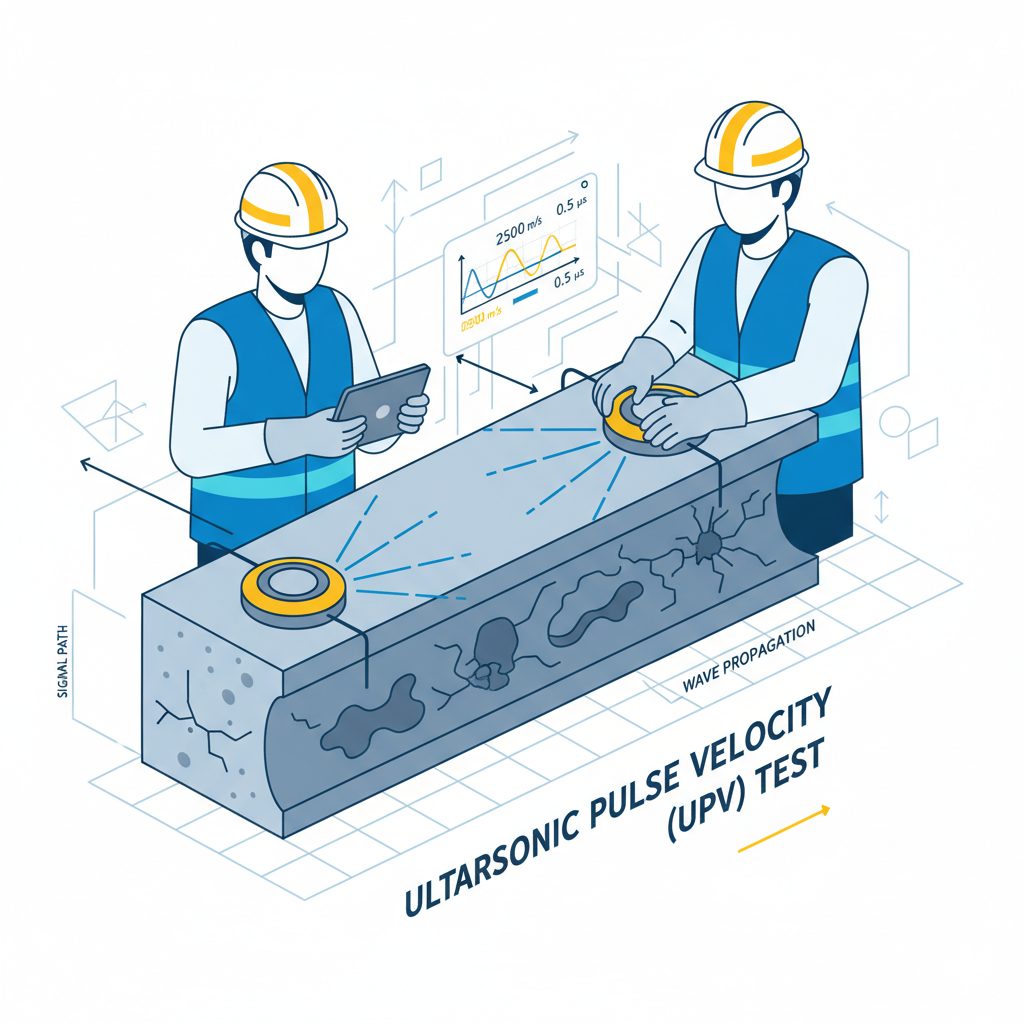
The Ultrasonic Pulse Velocity Test is a widely used non-destructive testing (NDT) method for concrete structures. It measures the time required for an ultrasonic pulse to travel through a known path length of concrete. The measured travel time is used to calculate the pulse velocity, which provides information about the uniformity and relative quality of concrete and can help identify internal discontinuities such as cracks and voids.
The current ASTM reference is ASTM C597-22, Standard Test Method for Ultrasonic Pulse Velocity Through Concrete. ASTM states that UPV can be used to assess the uniformity and relative quality of concrete, indicate the presence of voids and cracks, evaluate crack repairs, identify changes in concrete properties and assist in surveys of structures to estimate the severity of deterioration or cracking.
Another important international reference is BS EN 12504-4:2021, Testing concrete in structures – Determination of ultrasonic pulse velocity. The standard describes the measurement of ultrasonic longitudinal or transverse wave propagation through hardened concrete and identifies applications including assessment of uniformity, cracks, voids, changes in properties and dynamic physical properties.
In Bangladesh, UPV testing can be particularly valuable for assessing existing residential buildings, commercial structures, factories, bridges, government buildings, industrial facilities, concrete pavements, water-retaining structures and other reinforced-concrete infrastructure.
For QC LAB SOLUTION, UPV is an important structural NDT service that can help engineers and asset owners investigate concrete condition while minimizing damage to the structure.
What Is the Ultrasonic Pulse Velocity (UPV) Test?
The Ultrasonic Pulse Velocity Test is an in-situ non-destructive test used to assess the internal quality and uniformity of concrete by measuring the velocity of ultrasonic stress waves travelling through it.
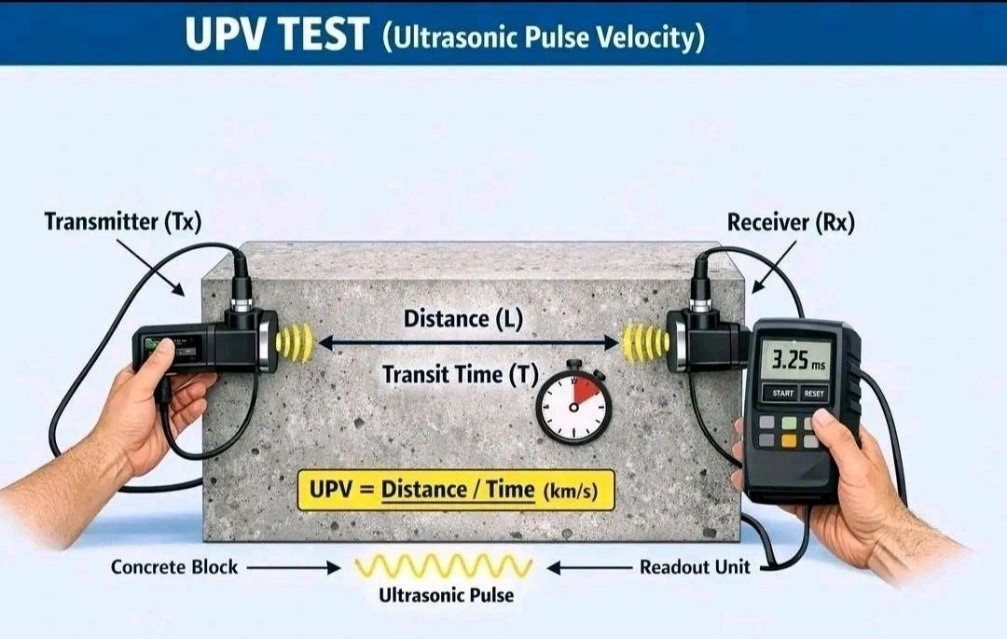
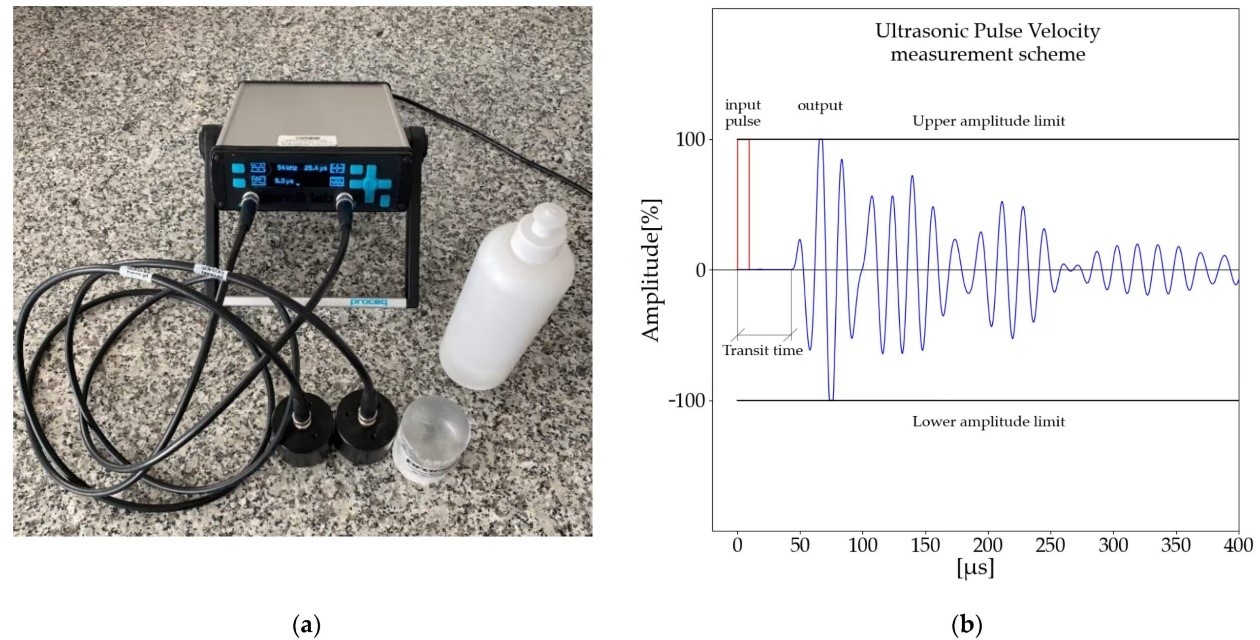
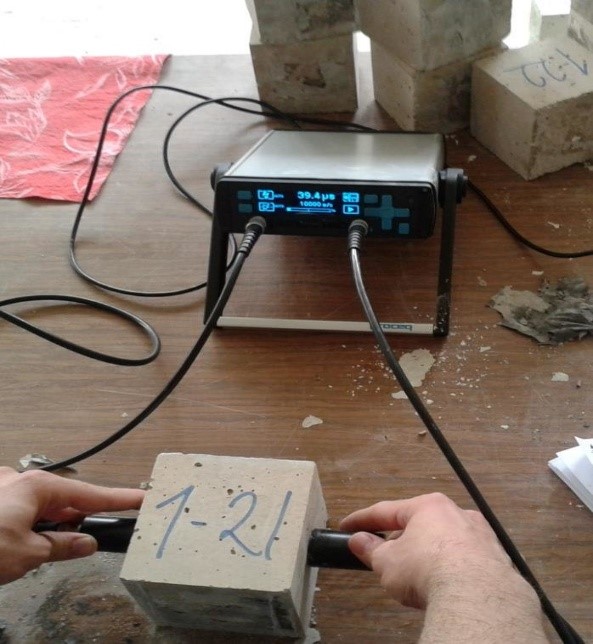
A UPV instrument consists primarily of a transmitting transducer and a receiving transducer. The transmitting transducer introduces an ultrasonic pulse into the concrete. The pulse travels through the concrete and is detected by the receiving transducer.
The instrument measures the transit time required for the pulse to travel between the two transducers.
The pulse velocity is then calculated using:
V = L / T
Where:
- V = ultrasonic pulse velocity
- L = path length through concrete
- T = measured transit time
For example, if the ultrasonic pulse travels through a 300 mm concrete path and the measured travel time is 80 microseconds:
V = 0.300 / 0.000080
V = 3,750 m/s
The measured velocity can then be interpreted alongside other information about the concrete and structure.
ASTM C597 specifically covers the determination of propagation velocity of longitudinal ultrasonic stress-wave pulses through concrete.
Why Is UPV Important as a Structural NDT Test?
Structural assessment frequently requires information about concrete that cannot be obtained through visual inspection alone.
A concrete surface may appear satisfactory while internal defects are present.
For example, a reinforced concrete beam may have:
- Internal honeycombing
- Poor compaction
- Voids
- Cracks
- Delamination
- Poor-quality concrete zones
- Construction joints
- Internal discontinuities
UPV provides an opportunity to investigate the concrete without cutting out large sections of the structural member.
The American Concrete Institute recognizes ultrasonic pulse velocity as one of the in-place methods used for evaluating concrete and estimating in-place properties, while broader NDT methods are used to assess the condition of structural concrete and identify internal flaws.
This makes UPV particularly useful during:
- New construction quality assessment
- Structural condition surveys
- Building renovation
- Structural rehabilitation
- Pre-purchase building assessment
- Investigation of suspected concrete defects
- Post-repair evaluation
- Infrastructure maintenance
- Forensic engineering investigations
Market Growth and Industry Trends for Structural NDT in Bangladesh
Bangladesh has experienced rapid construction and infrastructure development over the past several decades. Thousands of reinforced-concrete residential, commercial, industrial and institutional structures are now in service.
As these structures age, the need is shifting from simply constructing new buildings to also assessing, maintaining, rehabilitating and extending the service life of existing structures.
This creates increasing demand for structural NDT services.
Traditional destructive testing alone is often unsuitable for large buildings because extracting numerous cores can damage structural members and may not provide sufficient spatial coverage.
NDT methods such as UPV provide an alternative approach for investigating larger areas with minimal physical damage.
The growing structural NDT market in Bangladesh is being driven by several factors.
Aging Concrete Structures
Older buildings may experience deterioration due to:
- Environmental exposure
- Moisture
- Carbonation
- Corrosion of reinforcement
- Poor original construction
- Overloading
- Inadequate maintenance
- Fire exposure
- Repeated loading
Expansion and Renovation
Existing buildings are increasingly being renovated, extended or repurposed.
Before adding floors, changing occupancy or modifying structural members, engineers may require information about existing concrete quality.
High-Rise Construction
Modern buildings increasingly require systematic quality control during construction.
UPV can supplement other tests when engineers need to investigate concrete uniformity or suspected defective areas.
Infrastructure Maintenance
Bridges, culverts, concrete decks, industrial structures and other infrastructure require periodic condition assessment.
Government Projects
Public buildings and infrastructure represent a major potential market for structural NDT services because asset owners need reliable information before repair or rehabilitation decisions.
What Does UPV Measure?
The principal measured parameter is:
Ultrasonic Pulse Velocity
UPV represents the speed at which the ultrasonic stress wave travels through the tested concrete.
The measured velocity is influenced by several properties, including:
- Concrete density
- Elastic properties
- Aggregate type
- Aggregate content
- Moisture condition
- Age
- Microcracking
- Internal defects
- Concrete uniformity
- Test path
ASTM notes that ultrasonic pulse velocity is related to the elastic properties and density of concrete.
However, UPV should not be treated as a direct measurement of compressive strength.
This is an important distinction.
Can UPV Determine Concrete Compressive Strength?
UPV can be correlated with compressive strength, but the test does not directly measure compressive strength.
A universal equation such as:
UPV = X m/s → Concrete strength = Y MPa
should not be applied blindly to every concrete structure.
Concrete mixtures differ in:
- Cement type
- Aggregate type
- Aggregate size
- Water-cement ratio
- Admixtures
- Moisture condition
- Age
- Curing
- Construction method
Therefore, if strength estimation is required, a project-specific correlation may be developed using UPV measurements and compressive strength results from representative cores or other appropriate specimens.
ASTM C597 recognizes that a velocity-strength or velocity-modulus relationship can be established by measuring pulse velocity and compressive strength or modulus on a number of specimens of the same concrete.
Therefore:
UPV is primarily a concrete quality, uniformity and defect-assessment tool; strength estimation requires appropriate correlation and engineering judgment.
Key Applications of UPV Testing
1. Assessment of Concrete Uniformity
One of the most important applications of UPV is evaluating whether concrete throughout a structural member has reasonably consistent properties.
Multiple measurement points can be tested across:
- Columns
- Beams
- Slabs
- Walls
- Foundations
- Piles
- Bridge members
Areas with significantly different pulse velocities may indicate differences in concrete quality or internal condition.
ASTM specifically identifies uniformity and relative quality assessment as applications of UPV.
2. Detection of Cracks
UPV can help identify internal discontinuities that interfere with ultrasonic wave transmission.
A crack may cause:
- Increased travel path
- Reduced apparent velocity
- Signal attenuation
- Changes in waveform characteristics
By comparing measurements across different locations, engineers can identify anomalous areas requiring further investigation.
However, UPV alone should not automatically be interpreted as providing exact crack dimensions or depth in every situation.
3. Detection of Voids and Honeycombing
Poorly compacted concrete can contain internal voids or honeycombed zones.
These discontinuities can interfere with ultrasonic wave propagation.
UPV testing can therefore be used to identify suspicious areas that may require:
- Additional UPV measurements
- Impact-echo testing
- Ground penetrating radar
- Core sampling
- Visual inspection
- Other NDT techniques
BS EN 12504-4 identifies the presence of cracks and voids as an application of ultrasonic pulse velocity testing.
4. Evaluation of Concrete Repairs
UPV can be used to compare a repaired area with surrounding original concrete.
This can be useful for assessing:
- Crack repairs
- Concrete patch repairs
- Grouting
- Repair zones
- Localized strengthening
ASTM C597 specifically identifies evaluation of the effectiveness of crack repairs as one application of UPV.
5. Structural Condition Assessment
UPV can form part of a broader structural condition assessment program.
A typical investigation may combine:
Visual Inspection + UPV + Rebound Hammer + Rebar Scanning + Core Testing + Half-Cell Potential + Carbonation Testing
Each technique provides different information.
UPV is particularly useful for investigating the internal continuity and uniformity of concrete.
6. Investigation of Suspected Poor Concrete
If construction records indicate possible problems with:
- Low concrete strength
- Poor vibration
- Improper placement
- Cold joints
- Honeycombing
- Improper curing
UPV can be used as an initial screening technique to identify areas that deserve further investigation.
7. Monitoring Changes Over Time
UPV can be used for repeated measurements when the test locations are properly documented.
For example, measurements can be taken:
- Before repair
- Immediately after repair
- Six months later
- One year later
- During periodic structural inspection
ASTM recommends marking test locations when monitoring changes over time so that subsequent measurements can be taken at the same positions.
UPV Equipment Used for Structural NDT
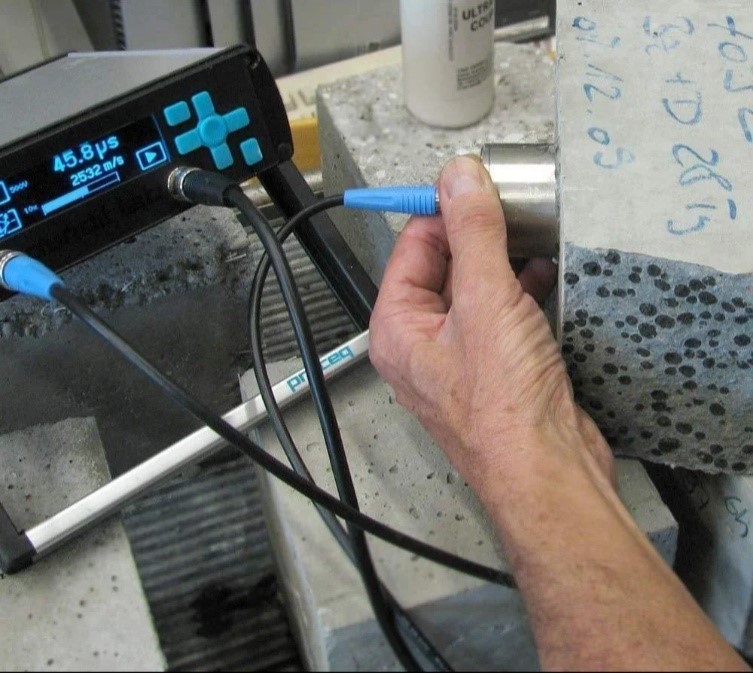
A professional UPV testing system generally includes:
Ultrasonic Pulse Velocity Instrument
The main electronic unit generates, receives and measures ultrasonic pulses.
Transmitting Transducer
This component introduces the ultrasonic pulse into the concrete.
Receiving Transducer
The receiving transducer detects the pulse after it has travelled through the concrete.
Connecting Cables
Cables connect the transducers to the instrument.
Coupling Agent
A suitable coupling medium is used between the transducers and concrete surface to improve transmission of ultrasonic energy.
Measuring Equipment
The path length between transducers must be accurately determined.
Calibration/Reference Accessories
The instrument should be checked according to the manufacturer's requirements before testing.
Documentation System
A professional investigation should record:
- Test location
- Structural member
- Path length
- Transit time
- Calculated velocity
- Concrete condition
- Surface condition
- Moisture condition
- Test orientation
- Remarks
UPV Test Configurations
UPV can generally be performed using different transducer arrangements depending on structural access.
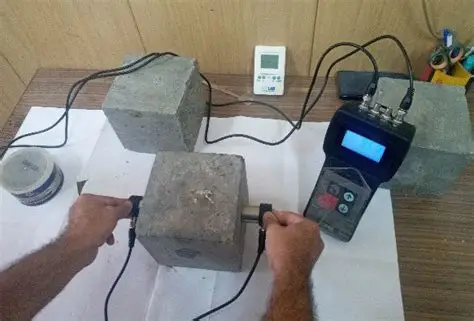
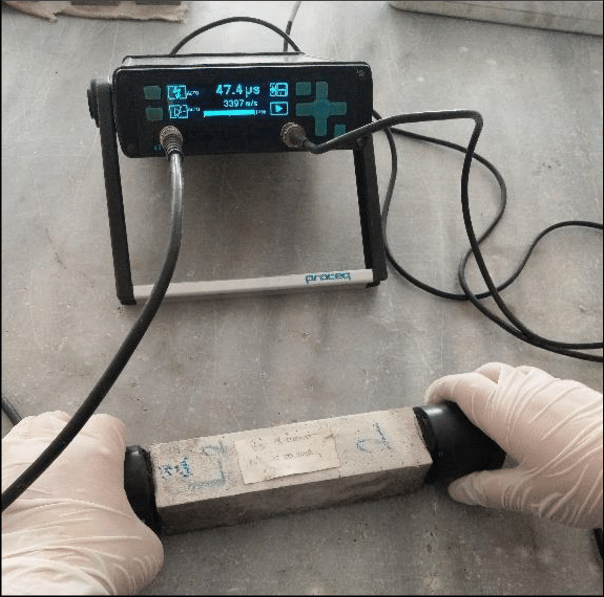
Direct Transmission
The transmitter and receiver are positioned on opposite sides of the concrete member.
The ultrasonic pulse travels directly through the member.
This arrangement generally provides the most straightforward transmission path and is preferred where access allows.
Examples include:
- Through a wall
- Through a column
- Through a concrete block
- Through a beam where both sides are accessible
Semi-Direct Transmission
The transducers are placed on two surfaces that are not directly opposite each other.
This arrangement can be useful where direct access is unavailable.
Indirect or Surface Transmission
Both transducers are placed on the same surface.
This arrangement is useful where only one surface is accessible, such as certain slabs or large structural elements.
However, interpretation differs from direct transmission, and the test arrangement should be properly documented.
ACI explains the basic UPV principle as measuring the time required for vibrational energy to travel through a concrete member from a transmitting transducer to a receiving transducer, with the direct path length divided by travel time to obtain pulse velocity.
UPV Test Working Procedure
Step 1: Review the Structure
Before testing, the engineer or technician reviews:
- Structural drawings
- Member dimensions
- Concrete age
- Construction history
- Previous test results
- Visible cracks
- Repair history
- Suspected defective areas
Where drawings are unavailable, a visual survey can be conducted before testing.
Step 2: Select Test Locations
Test locations should represent the area being investigated.
Locations may include:
- Columns
- Beams
- Slabs
- Walls
- Foundations
- Pile caps
- Bridge components
Additional points should be selected around visibly damaged or suspicious areas.
Step 3: Prepare the Surface
The concrete surface should be prepared sufficiently to establish proper contact between the transducer and concrete.
Loose materials, dust, coatings or surface irregularities that interfere with coupling may need to be removed or addressed.
Step 4: Measure the Test Path
The distance between the transmitting and receiving transducers is measured accurately.
The path length is critical because velocity is calculated using:
Velocity = Path Length / Transit Time
Step 5: Apply Couplant
A suitable coupling agent is applied between the transducer and concrete surface.
Good coupling is essential for efficient transmission and reception of the ultrasonic pulse.
Step 6: Position the Transducers
The transducers are placed according to the selected test configuration.
The technician ensures that:
- Contact is stable
- Coupling is adequate
- Transducers are correctly positioned
- Test geometry is recorded
Step 7: Generate Ultrasonic Pulse
The transmitting transducer sends an ultrasonic pulse into the concrete.
The pulse travels through the structural member.
Step 8: Detect the Pulse
The receiving transducer detects the pulse after it has travelled through the concrete.
The instrument measures the transit time.
Step 9: Calculate Pulse Velocity
The instrument or technician calculates:
V = L/T
where:
- V = pulse velocity
- L = path length
- T = transit time
Step 10: Repeat Measurements
Multiple locations should be tested where the objective is to evaluate concrete uniformity.
Additional readings can be taken around:
- Cracks
- Honeycombing
- Construction joints
- Suspected weak areas
- Repair zones
Step 11: Analyze the Results
The measured velocities are compared between test locations.
Anomalously low or inconsistent readings may indicate areas requiring further investigation.
Results should be interpreted together with:
- Visual inspection
- Structural drawings
- Concrete age
- Moisture condition
- Reinforcement information
- Other NDT results
- Core results where available
Working Steps on Field
A typical field UPV investigation can be summarized as:
Site inspection
↓
Review structural information
↓
Select test locations
↓
Identify structural members
↓
Prepare concrete surface
↓
Measure path length
↓
Select transmission arrangement
↓
Apply coupling agent
↓
Position transmitting and receiving transducers
↓
Generate ultrasonic pulse
↓
Record transit time
↓
Calculate UPV
↓
Repeat at required locations
↓
Compare results
↓
Identify anomalous areas
↓
Conduct supplementary testing if required
↓
Prepare technical report
This systematic approach ensures that the UPV results are useful for structural assessment rather than simply producing isolated velocity numbers.
Factors Affecting UPV Test Results
UPV is a powerful test, but the measured velocity can be influenced by several factors.
Moisture Condition
Concrete moisture has a significant effect on pulse velocity.
ASTM notes that the degree of saturation affects UPV and that pulse velocity in saturated concrete may be up to approximately 5% higher than in dry concrete.
Therefore, moisture conditions should be recorded during testing.
Aggregate Type
The type and properties of aggregate can significantly affect pulse velocity.
Concrete containing different aggregate types may produce different UPV values even when the concrete has similar compressive strength.
Therefore, universal velocity-strength relationships should be avoided.
Reinforcement
Steel reinforcement can influence the measured pulse velocity because ultrasonic waves can travel through steel at a different velocity from concrete.
The location and orientation of reinforcement should therefore be considered during interpretation.
Where necessary, reinforcement should be located using a cover meter or GPR before UPV testing.
Path Length
The distance between the transducers must be accurately measured.
Incorrect path length produces incorrect velocity calculations.
Surface Condition
Poor contact between the transducer and concrete can affect signal transmission.
Surface preparation and appropriate coupling are therefore important.
Cracks
Cracks can increase the effective travel path or interrupt direct transmission.
The location, orientation and width of cracks should be considered during interpretation.
Concrete Age
The concrete's age and curing history can influence its physical properties and UPV.
Frequency of Transducer
The selected transducer frequency should be appropriate for the structural member and required test path.
Longer paths and highly attenuating concrete may require different transducer characteristics than short laboratory-type paths.
ASTM notes that transducer frequency affects signal attenuation and transit-time measurement sensitivity.
Interpretation of UPV Results
One of the most common mistakes in UPV testing is treating a single velocity number as an absolute measurement of concrete strength.
A better approach is to evaluate relative quality and uniformity while considering the concrete's composition and environmental condition.
In practice, engineers may categorize concrete according to velocity ranges for preliminary interpretation, but these classifications should be treated as guidance rather than universal acceptance criteria.
For example, a project may use a velocity classification such as:
|
UPV Range |
General Interpretation* |
|
Higher velocity |
Generally indicates more continuous/dense concrete |
|
Intermediate velocity |
May indicate generally acceptable but variable concrete |
|
Lower velocity |
May indicate poorer quality or discontinuity |
|
Very low velocity |
Requires investigation for cracks, voids or other defects |
Site and Health Safety for UPV Testing
Although UPV itself is a non-destructive test and generally does not involve major structural damage, field testing can still involve safety risks.
Technicians may need to work:
- At height
- On scaffolding
- On roofs
- Near traffic
- Inside construction sites
- Near electrical systems
- Around heavy equipment
- In confined areas
Important safety measures include:
- Use appropriate PPE.
- Use certified access equipment.
- Secure ladders and scaffolding.
- Use fall protection where required.
- Maintain electrical safety.
- Keep cables organized.
- Avoid trip hazards.
- Restrict access to testing areas.
- Follow site-specific safety procedures.
- Do not perform testing in unsafe structural areas without appropriate engineering assessment.
The UPV standard itself does not eliminate the responsibility to establish suitable safety and health practices. ASTM places responsibility on users to determine appropriate safety practices for the application.
Advantages and Benefits of UPV Testing
Non-Destructive
The greatest benefit is that UPV does not require cutting or removing significant portions of the concrete.
Rapid Testing
A large number of locations can often be tested during a relatively short field campaign.
Minimal Damage
Testing generally leaves little or no visible damage to the concrete surface.
Internal Quality Assessment
UPV provides information related to internal concrete continuity that cannot be obtained through visual inspection alone.
Crack and Void Investigation
The method can help identify areas affected by internal discontinuities.
Uniformity Assessment
Multiple measurements can map variations across structural members.
Repair Evaluation
UPV can help compare repaired and surrounding concrete.
Useful for Existing Structures
The technique is especially valuable for aging buildings and infrastructure.
Supports Integrated NDT
UPV can be combined with rebound hammer, GPR, rebar scanning, half-cell potential, core testing and other methods.
QC LAB SOLUTION's Contribution to UPV Structural NDT Services
QC LAB SOLUTION provides civil engineering, structural testing, laboratory and technical services in Bangladesh.
Our UPV service is intended to support clients who need non-destructive information about the condition and uniformity of concrete structures.
Our service approach can include the following stages.
1. Project Requirement Review
We first understand:
- Structure type
- Construction age
- Investigation objective
- Areas of concern
- Available drawings
- Previous test results
- Required reporting format
2. Visual Structural Inspection
Where included in the scope, visible conditions can be documented before UPV measurements.
These may include:
- Cracks
- Spalling
- Honeycombing
- Surface deterioration
- Repair zones
- Construction joints
- Water leakage
3. Test Location Planning
UPV locations are selected systematically across the structural members.
Additional locations can be selected around suspicious areas.
4. Field UPV Testing
Our technical team can perform UPV measurements using suitable equipment and testing configurations.
5. Data Recording
The test records can include:
- Structural member
- Test location
- Path length
- Transit time
- UPV
- Surface condition
- Moisture condition
- Test configuration
- Remarks
6. Data Interpretation
Results can be reviewed to identify:
- Relative uniformity
- Anomalous zones
- Potential discontinuities
- Areas requiring further investigation
7. Integrated Testing
Where necessary, UPV can be combined with:
- Rebound Hammer Test
- Rebar Detection
- Cover Meter Test
- Ground Penetrating Radar
- Half-Cell Potential
- Carbonation Depth Test
- Core Testing
- Other structural NDT methods
8. Technical Reporting
The final report may include:
- Project information
- Test methodology
- Applicable standards
- Equipment details
- Test locations
- Raw measurements
- UPV calculations
- Tables
- Graphs
- Structural observations
- Anomaly identification
- Engineering interpretation
- Recommendations for additional investigation where appropriate
Our objective is to provide clients with clear, traceable and engineering-useful NDT information, rather than simply reporting a collection of UPV values.
The Ultrasonic Pulse Velocity (UPV) Test is an important structural non-destructive testing technique for evaluating the condition, uniformity and relative quality of concrete.
Unlike destructive testing methods that require removal of concrete, UPV allows engineers to investigate concrete members with minimal physical disturbance. The method works by transmitting an ultrasonic pulse through concrete and measuring its travel time between known points.
The resulting pulse velocity can provide valuable information about:
- Concrete uniformity
- Relative quality
- Internal discontinuities
- Cracks
- Voids
- Honeycombing
- Repair effectiveness
- Changes in concrete condition
ASTM C597-22 specifically identifies these applications, while BS EN 12504-4:2021 provides another internationally recognized framework for UPV testing of concrete structures.
However, UPV should not be treated as a standalone measurement of concrete compressive strength. Concrete composition, moisture, aggregate type, reinforcement, path length, surface condition and other factors can influence the measured velocity. For strength estimation, an appropriate project-specific correlation is necessary.
For existing buildings and infrastructure in Bangladesh, UPV can be particularly valuable as part of a broader structural condition assessment. It allows engineers to test a larger number of locations with minimal damage and identify areas that may require more detailed investigation.
QC LAB SOLUTION provides structural NDT and civil engineering testing support in Bangladesh, helping government organizations, developers, contractors, consultants, industrial clients and property owners investigate concrete structures using professional testing approaches.
For critical structural assessments, the most effective approach is often not one test, but an integrated investigation combining:
Visual Inspection + UPV + Rebound Hammer + Rebar Detection + GPR + Core Testing + Other Appropriate NDT Methods
With the right testing methodology, quality control and engineering interpretation, UPV can become a valuable tool for making informed decisions about structural safety, repair, rehabilitation, maintenance and the remaining service life of concrete structures.