Beam molds

The proposed models range from the traditional steel models conforming to ASTM standards, to the slitting plastic models, very practical for field use and ideal for production control.
  • Highlights
  • Features
  • Specification
  • Models
  • Standards
  • Review (2)

Beam molds Price in Bangladesh

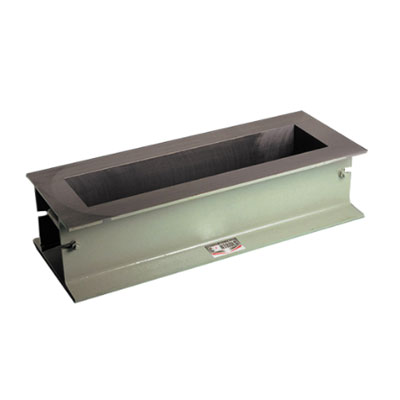
Beam molds are essential laboratory equipment for preparing concrete beam specimens, and Beam molds Price in Bangladesh provides a practical solution for accurate and consistent specimen moulding. Designed for construction material testing, these molds help laboratories and quality control teams produce uniform concrete samples for further evaluation.

Manufactured with durable materials, beam molds are designed to withstand repeated use in demanding laboratory and construction environments. Their sturdy construction helps maintain shape and dimensional stability during concrete filling, compaction, curing, and specimen removal.

The practical design makes these molds convenient to assemble, fill, clean, and reuse. Smooth internal surfaces can support easier demoulding while helping produce well formed concrete specimens. Their reliable construction also contributes to consistent sample preparation, which is important for obtaining dependable test results.

Beam molds are suitable for testing laboratories, construction companies, concrete manufacturers, educational institutions, and research facilities. They can be used with appropriate concrete testing equipment to prepare specimens for strength and quality assessment according to applicable testing procedures.

Choosing high quality beam molds can improve laboratory efficiency and specimen consistency while reducing complications during repeated testing. With robust construction, convenient handling, reusable design, and dependable performance, these molds are a valuable addition to professional concrete testing facilities.


The proposed models range from the traditional steel models conforming to ASTM standards to the slitting plastic models, very practical for field use and ideal for production control.

Plastic beam molds
A one-piece mold manufactured from a robust plastic that is resistant to shock and abrasion. Ideal for field use, the specimen is ejected from the mold by com­pressed air requiring only a simple clean and oiling before being ready for use again.
Two sizes available: 100 x 100 x 500 mm (model 55-C0100/PB11) and 150 x 150 x 600 mm (model 55-C0100/PB15).

Steel beam molds
Three sizes available: 100 x 100 x 400 (model 55-C0100/MB10), 100 x 100 x 500 (model 55-C0100/MB11) and 150 x 150 x 600 (model 55-C0100/MB15).

Guidelines for proper use of molds:
The list below is by no means exhaustive but wants to give some recommendations for correct use of molds. For more information, please always refer to the user manual.

  • Molds must be kept clean and free from residues. This is essential to extend the lifespan of the molds and prevent any defects on sample surfaces. Clean the molds of any residues within 24 hours after demolding to prevent encrustations and rust.
  • Before casting, it is strongly recommended coat the internal mold faces with a thin layer of a demolding agent (e.g. cod. C0139/A) that facilitates removal of hardened samples during demolding operations.

Additionals for Plastic Molds (as C0100/Pxxx):

  • Mould bottom hole shall be closed with a bung (when present).
  • A piece of anti-stick paper (when present) shall be placed on the bottom of the mould to avoid any sample base adhesion.
  • Before casting, it is strongly recommended coat the internal mold faces with a thin layer of a demolding agent (e.g. cod. C0139/A).
  • Demolding shall be done within the first 24 hours of curing and not later than 3 days to ensure easy removal of hardened samples without any mould damage.
  • For making easier demoulding operations, it is possible use compressed air applied to the bottom hole of the mould (if present). Pressure shall not exceed 3 atm (43.5 psi) to avoid any mould damage.

Note that:

  • Plastic molds are suitable for sample curing according to reference standards (usually 20 ± 5°C) and they shall not be used for any accelerated curing treatments at high temperature, including steam curing.
  • Plastic molds shall not be used in case of accelerated concrete or expansive concrete mixes.
Code Description
55-C0100/MB11 Concrete beam mould 100 × 100 × 500 mm
55-C0100/MB16 Concrete beam mould 150 × 150 × 750 mm
55-C0100/PB10 Plastic beam mould, 100 × 100 × 400 mm. Weight 2 kg
55-C0100/MB10 Concrete beam mould 100 × 100 × 400 mm
55-C0100/MB15 Concrete beam mould 150 × 150 × 600 mm
55-C0100/PB11 Plastic beam mould 100 × 100 × 500 mm, complete with stopper
55-C0100/PB15 Plastic beam mould 150 × 150 × 600

2 Reviews For win Your Friends

Add Your Review

Your Rating:
Steven Rich – Sep 17, 2016:
How all this mistaken idea of denouncing pleasure and praising pain was born and I will give you a complete account of the system, and expound the actual teachings.
William Cobus – Aug 21, 2016:
There anyone who loves or pursues or desires to obtain pain itself, because it is pain sed, because occasionally circumstances occur some great pleasure.

Any question about the Beam molds ?

* indicates required fields

CAPTCHA